Getting found in local Google searches can help a business attract nearby customers, generate enquiries and build a stronger reputation. But how local businesses can rank on Google is not simply a matter of adding a town name to a website or asking customers for reviews. Sustainable local visibility comes from accurate business information, relevant pages, a helpful website and genuine signals of trust.
Google explains that local results are mainly shaped by relevance, distance and prominence. You cannot control every factor, such as a searcher’s location, but you can make your business information clearer and your online presence more useful. This guide covers practical steps local businesses can take without relying on ranking guarantees or shortcuts.
1. Understand Google’s local ranking factors
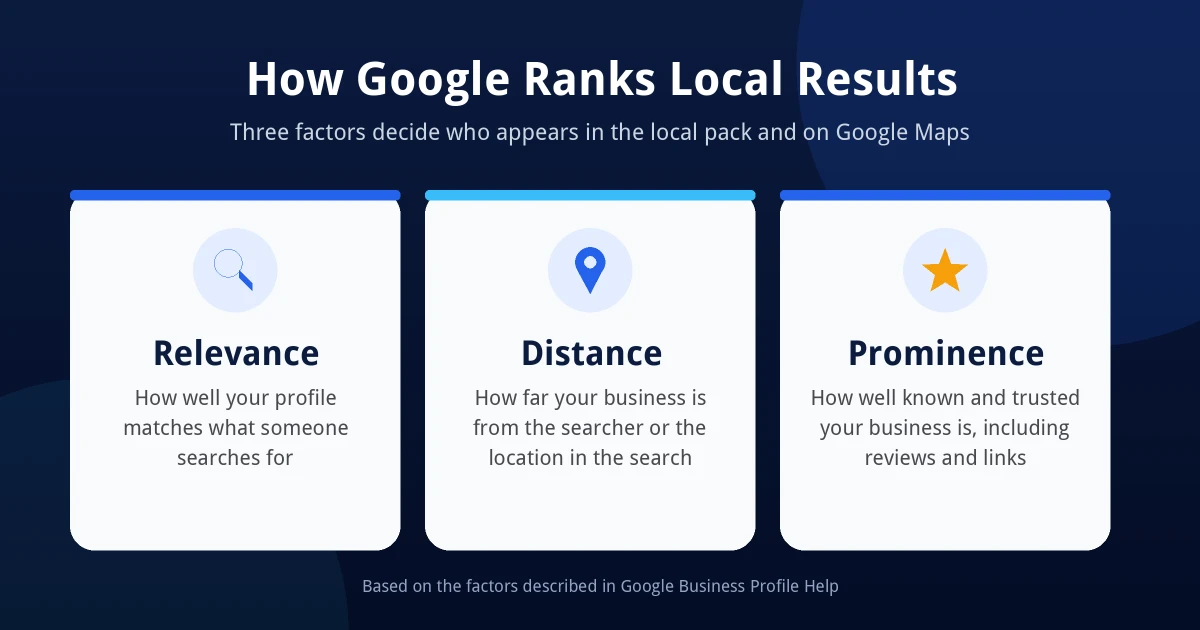
Before changing your website, understand the broad factors that shape local results. Google’s official guidance describes three key considerations:
- Relevance: how well your Business Profile and web pages match what the person is looking for.
- Distance: how far the business is from the searcher or the location included in the query.
- Prominence: how well-known and trusted a business appears, informed by factors such as information Google finds across the web, links and reviews.
You cannot make a business rank in every neighbourhood just by repeating place names. Focus on accurate details, a clear service offering, useful local pages and real evidence that customers value your business. Read Google’s guidance on improving local ranking for the source principles.
2. Complete and maintain your Google Business Profile
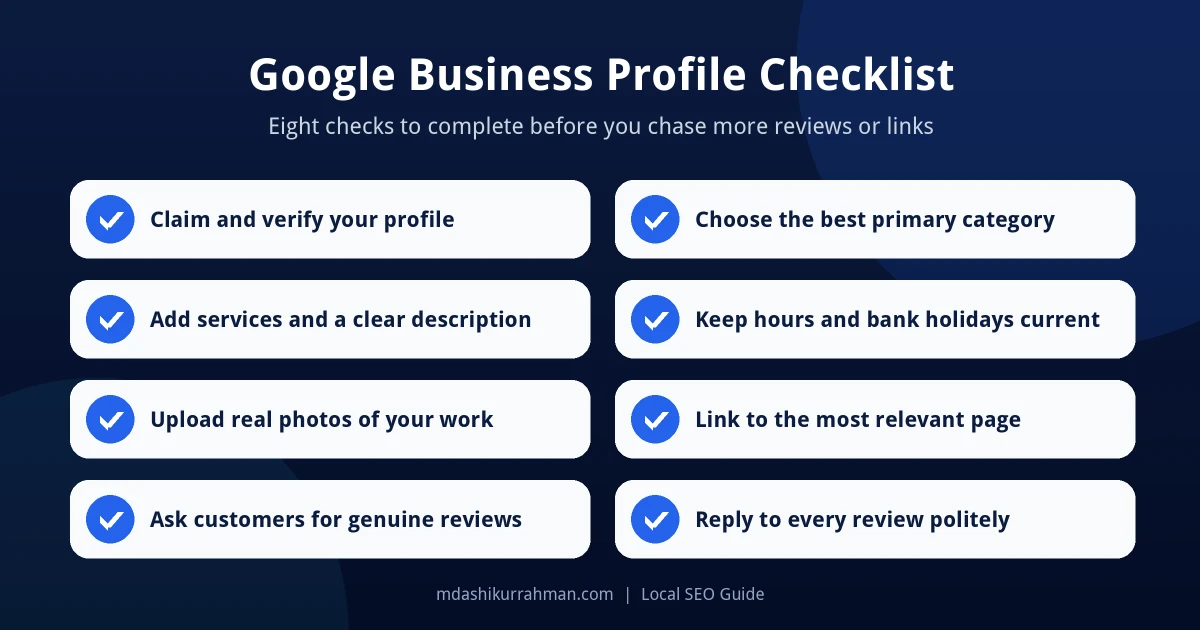
For an eligible local business, the Google Business Profile is a central part of local visibility. Claim and verify the profile, select the most accurate primary category, add relevant secondary categories where appropriate, and complete the fields that genuinely apply to your business.
- Use your real-world business name rather than adding extra keywords.
- Choose the most accurate business category.
- Keep opening hours, phone number, website and service information up to date.
- Add clear, current photographs of your premises, team, products or completed work.
- Set the address or service area according to how the business actually operates.
- Review profile information periodically, especially after business changes.
Do not create duplicate profiles or use a virtual address that does not meet Google’s rules. A profile should represent a real business accurately, not try to manipulate the map results.
3. Research local keywords and search intent
Local keyword research helps you understand the words customers use when they need your service. Start with your core service, the locations you genuinely serve and the questions customers ask before contacting you. For example, a customer might search for “emergency plumber in Leeds”, “family solicitor near me” or “commercial cleaning in Bristol”.
Look at the actual search results to understand the intent behind each phrase. Some searches lead to map listings, while others show service pages, guides or directories. Choose a page type that matches what the searcher wants instead of trying to make one page rank for every possible variation.
Group closely related terms by intent. A service page might target a main service and location, while a blog article can answer a useful question. Avoid repeating the same phrase unnaturally; use clear language that helps customers understand what you do.
4. Build useful service and location pages
Your website should confirm the services and locations shown in your Business Profile. Give every core service a clear page with a descriptive heading, an explanation of what is included, who the service helps, common customer questions and an obvious way to make contact.
Location pages can be useful when a business genuinely serves multiple areas, but each page needs unique value. Include locally relevant service details, real projects or examples where available, practical information about coverage and answers to questions people in that area may have. Do not publish dozens of near-identical pages that only swap one town name for another.
Start with a strong main service page and create additional location pages only where you can offer specific, helpful information. If you need a wider strategy, review my SEO services and the existing guide to improving local SEO in the UK.
5. Improve on-page SEO across important pages
On-page SEO makes each page easier for people and search engines to understand. Give the page a unique title tag and meta description, use one clear main heading, and organise supporting ideas with descriptive subheadings. Mention the service and location naturally where it helps the reader.
Also make sure that important pages are linked from relevant pages on your website. Use descriptive anchor text that tells visitors what they will find, such as on-page SEO, instead of relying on repeated “click here” links. Compress images, write meaningful alt text and make contact details easy to find on mobile.
A page should answer the visitor’s main questions before asking for a sale. Avoid keyword stuffing, hidden text and copied content. These tactics can reduce usability and do not provide a sustainable local SEO strategy.
6. Earn genuine customer reviews and respond professionally
Reviews help potential customers judge whether a business is right for them, and they can contribute to local prominence. Build a repeatable process for inviting genuine customers to share honest feedback after a real interaction.
- Ask customers in a neutral, polite way after a completed job or service.
- Make it easy to find the correct review link.
- Never buy reviews, create fake reviews or offer rewards in exchange for positive ratings.
- Respond calmly to positive and negative feedback without exposing private customer information.
Do not ask only customers you expect to leave positive feedback. A credible review profile reflects real experiences. Reviews support trust, but no business can guarantee a particular ranking by collecting a specific number of them.
7. Keep business details consistent across the web
Check the business name, address and phone number shown on your website, Business Profile and important directories. Correct meaningful inconsistencies, especially if the business has moved, changed phone numbers or updated its name. Prioritise established, relevant directories rather than submitting your details indiscriminately to hundreds of low-quality sites.
If your business serves customers at their locations and does not receive visitors at its address, follow Google’s service-area business rules and avoid presenting a private address as a public storefront. Accuracy matters more than creating the appearance of a larger footprint.
8. Fix technical SEO issues that block visibility
Even useful local content can struggle if search engines cannot access or understand it. Check that important pages return a normal status code, are not accidentally marked noindex, are not blocked from crawling and have sensible canonical URLs. Submit the XML sitemap in Google Search Console and link key pages from relevant navigation or content.
Review mobile usability and page speed as well. Make phone numbers tappable, keep forms simple and avoid intrusive elements that make it difficult to contact the business. My technical SEO services cover common crawling, indexing and site-performance issues.
For implementation guidance, use Google’s SEO Starter Guide and its documentation on crawling and indexing. These sources explain how Google discovers pages and why a technically accessible site is important.
9. Build local authority with relevant links and community involvement
Links can help people discover your business and give search engines context about your website. Look for legitimate opportunities that fit your business: local business associations, professional bodies, community projects, supplier or partner pages, local events and useful public resources.
Prioritise relationships and genuinely relevant mentions over paid link schemes, automated link packages or unrelated directories. A smaller number of relevant, earned links is more useful than a large collection of manipulative links. You can learn more about off-page SEO and how it supports a broader search strategy.
10. Show experience and build customer trust
Give visitors reasons to trust your business. Explain who provides the service, what your process looks like, how customers can contact you and what happens after an enquiry. Add genuine team or project photographs where appropriate, clear service terms and accurate business information.
For content, identify the author, cite reliable sources for important claims and update information when it changes. Only publish case studies, testimonials, qualifications or performance figures that you can substantiate. Trust comes from being specific and honest, not from making unsupported claims.
11. Measure local SEO performance every month
Use Google Business Profile performance data, Google Search Console and your analytics platform to understand what is improving. Review search queries, impressions, clicks, landing pages and valuable actions such as calls, contact-form submissions, bookings or direction requests where available.
Compare performance over time rather than reacting to one day’s changes. If a page gets impressions but few clicks, review its title and description. If visitors arrive but do not enquire, check whether the page answers their questions and makes the next step clear. If a page is not indexed, investigate technical issues before rewriting it repeatedly.
A simple local SEO action plan
- Week 1: Audit the Business Profile, business details, important website pages and indexing status.
- Week 2: Research service and location keywords; improve the main service pages and their internal links.
- Week 3: Set up a compliant process for requesting genuine reviews and correct important directory listings.
- Week 4: Review technical SEO, mobile usability and performance data; prioritise the next improvements based on evidence.
After the first month, keep the profile accurate, publish genuinely useful content when it serves customers, and review results regularly. Local SEO is an ongoing process, not a one-time setting.
Frequently asked questions
How long does local SEO take to work?
There is no fixed timeline. Results depend on the market, the business’s starting point, competition, proximity and the work needed. Some improvements can make information clearer quickly, while stronger visibility may take longer. No ethical SEO provider can guarantee a specific position or date.
Does a business need a website to appear on Google Maps?
An eligible business can have a Google Business Profile without a website, but a useful website can provide more information about its services, areas served and customer questions. Keep all profile information accurate and follow Google’s eligibility policies.
Do more reviews guarantee a higher local ranking?
No. Reviews can support trust and prominence, but local results depend on multiple factors. Focus on authentic feedback and a good customer experience rather than pursuing a number as a ranking shortcut.
Should I create a page for every town nearby?
Only create a page when it provides distinct, useful information for people in that location and reflects where you genuinely work. Thin pages that repeat the same copy with a different town name are unlikely to help users.
Can I guarantee that my business will rank first?
No. Search results vary by query, location and other factors, and Google does not offer a legitimate way to guarantee the first position. A sound strategy improves the quality and clarity of your online presence without promising a specific outcome.
Final thoughts
Understanding how local businesses can rank on Google starts with the fundamentals: a complete and accurate Business Profile, useful service and location pages, genuine reviews, consistent business details, technically accessible content and trusted local mentions. Make changes based on what customers need and measure results over time.
If you need help identifying the highest-priority improvements for your website, explore my SEO services or contact me for a consultation.
About the author: Md Ashikur Rahman is an SEO specialist focused on on-page SEO, technical SEO, local search optimisation and Google Business Profile improvements.