
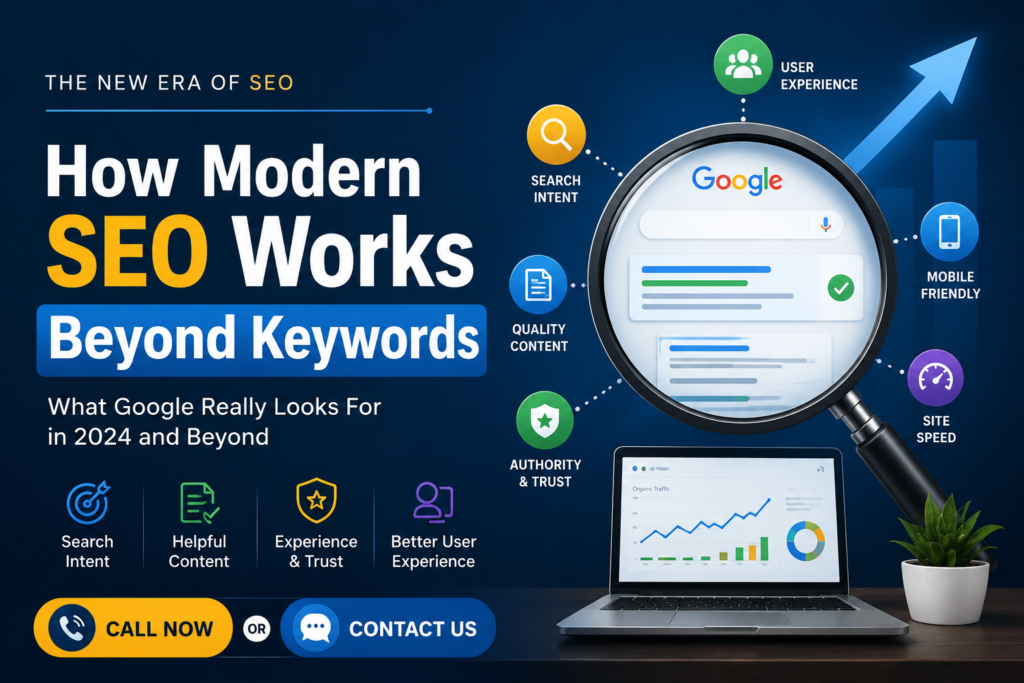
How Modern SEO Works Beyond Keywords: What Google Really Looks For
SEO has changed significantly over the years. Many people still believe that using a target keyword repeatedly is the key to ranking higher. But how modern SEO works beyond keywords is much more sophisticated than simply increasing keyword frequency.
Today, Google aims to understand what users are searching for, what they actually need, and which content can provide the most helpful and reliable answer.
Keywords still matter—but they are only one part of the bigger SEO picture.
How Modern SEO Works Beyond Keywords
When someone searches on Google, the search engine doesn’t simply look for pages containing the exact words from the query. It also tries to understand the meaning behind the search, the user’s intent, and which results are most relevant to that particular query.
For example, someone searching for:
“best dentist in Riyadh”
is probably not looking for a basic definition of dentistry.
They may be trying to compare dentists, evaluate their options, read reviews, and eventually choose a clinic.
A page that understands and satisfies that intent can be much more useful than a page that simply repeats the phrase “best dentist in Riyadh” dozens of times.
This is one of the most important concepts behind how modern SEO works beyond keywords.
Keywords Still Matter — But Keyword Stuffing Doesn’t
Keywords help search engines understand the subject of a page. Using relevant words naturally in your title, headings, content, URLs, and links can help communicate what a page is about.
The problem begins when keywords are inserted unnaturally just to manipulate rankings.
For example:
“Best dentist in Riyadh offers the best dentist services from the best dentist in Riyadh for people looking for the best dentist in Riyadh.”
This doesn’t create value for the reader.
Instead, a strong page would naturally discuss:
- Dental treatments
- Dentist qualifications
- Experience
- Patient reviews
- Clinic information
- Treatment options
- Frequently asked questions
- Location and contact information
The keyword helps define the topic, but the quality and usefulness of the overall page are much more important than simply repeating the keyword.
Search Intent Comes First
Before creating any SEO content, ask one simple question:
What does the user actually want?
Search intent can vary significantly from one query to another.
For example:
“What is dental implant treatment?”
→ Informational intent
“Best dentist in Riyadh”
→ Commercial/local investigation
“Dental clinic Riyadh”
→ Local/service discovery
“Book dentist appointment Riyadh”
→ Transactional intent
Each query requires a different type of content.
If you understand the intent correctly, you can create a page that actually solves the user’s problem instead of simply matching a keyword.
Helpful Content Creates Real Value
A modern SEO strategy should focus on creating content primarily for people.
Google’s guidance emphasizes helpful, reliable, people-first content rather than content created mainly to manipulate search rankings.
A useful page should provide information that helps the reader:
- Understand a topic
- Compare options
- Solve a problem
- Make a decision
- Take the next appropriate action
Ask yourself:
“Would this content still be useful if search engines didn’t exist?”
If the answer is yes, you’re probably creating content for the right reason.
Original insights, first-hand experience, expert explanations, examples, research, and useful information can make a page significantly more valuable.
Experience and Trust Matter
One of the strongest differences between weak and strong content is evidence.
Imagine a dental website saying:
“We are the best dentist in Riyadh.”
That’s simply a claim.
Now imagine another website showing:
- Qualified dental professionals
- Years of experience
- Genuine patient reviews
- Treatment information
- Real clinic details
- Professional credentials
- First-hand experience
- Clear information about the services
The second website gives users much more reason to trust the business.
This is where **E-E-A-T—Experience, Expertise, Authoritativeness, and Trustworthiness—**becomes an important SEO concept.
However, E-E-A-T shouldn’t be treated as a single ranking score. Instead, think about whether your website demonstrates real experience, expertise, authority, and trust.
Don’t just say you’re the best.
Give people reasons to believe you.
Internal Linking Builds a Strong Website Structure
Internal linking is another important part of modern SEO.
Imagine a dental website with these pages:
Dental Implants
↓
Dental Implant Cost
↓
Dental Implant Procedure
↓
Best Dentist in Riyadh
↓
Book an Appointment
Relevant internal links help users discover related information and help search engines understand the relationship between different pages.
Internal links can also help search engines discover URLs across a website.
But internal linking should always be natural and relevant.
Don’t add links simply because you want to insert more keywords.
Build links to improve navigation, context, and discoverability.
User Experience Still Matters
Even excellent content won’t create a great website if the user experience is poor.
Modern SEO should consider the overall experience users have when visiting a page.
Important areas include:
- Mobile usability
- Page speed
- Clear navigation
- Readable content
- Logical page structure
- Helpful visuals
- Secure browsing
- Clear calls to action
- Good Core Web Vitals where applicable
A visitor should be able to quickly understand:
What is this page about?
Does it answer my question?
Can I trust this information?
What should I do next?
SEO is not simply about bringing people to your website.
It’s about giving them a reason to stay, trust your information, and take the next step.
Technical SEO Is Still Essential
Content quality is important, but search engines also need to be able to access, crawl, render, and understand your website.
A professional SEO strategy should consider:
- Crawlability
- Indexability
- Robots.txt
- XML sitemaps
- Canonical URLs
- Redirects
- HTTP status codes
- JavaScript rendering
- Mobile-first considerations
- Site architecture
- Internal linking
- Duplicate content
- Page performance
- Structured data
A great article cannot perform properly if search engines cannot access or process it correctly.
Modern SEO Goes Beyond Traditional Search Results
Search is no longer limited to the traditional list of blue links.
Depending on the query, Google can show:
- Organic results
- Featured snippets
- People Also Ask
- Local results
- Images
- Videos
- Shopping results
- Knowledge panels
- AI-powered search experiences
Google has also introduced AI-powered experiences such as AI Overviews and AI Mode.
This means SEO professionals increasingly need to think about search visibility across different search experiences, rather than focusing only on achieving a traditional blue-link ranking.
The fundamentals, however, remain important:
Create useful information. Make it accessible. Demonstrate experience. Build trust. Understand your audience.
AEO and GEO in Modern Search
As search becomes more AI-driven, you’ll hear terms such as AEO (Answer Engine Optimization) and GEO (Generative Engine Optimization) more frequently.
The terminology is evolving, but the underlying principle is straightforward:
Make your content easy for search and answer systems to understand and evaluate.
That means focusing on:
- Clear answers
- Strong topical relevance
- Accurate information
- Original insights
- Demonstrable expertise
- Strong entity context
- Useful supporting information
- Credible sources where appropriate
Rather than chasing every new SEO acronym, focus on the fundamentals that make content genuinely valuable.
The Modern SEO Mindset
Old-school SEO often looked like this:
Keyword → Article → Backlinks → Rankings
A stronger modern approach looks more like:
Query → Search Intent → Relevant Content → Technical Accessibility → Experience → Trust → Authority → Search Visibility
This shift is important.
Instead of asking only:
“What keyword should I rank for?”
Ask:
“What does the searcher actually need?”
“How can I make this page genuinely better than competing results?”
“What evidence supports the information I’m providing?”
“Can both users and search engines easily understand this page?”
These questions lead to better SEO decisions.
Final Thoughts
Understanding how modern SEO works beyond keywords means understanding that SEO is no longer simply about placing keywords on a page.
Keywords still help search engines understand your content, but strong SEO combines many elements:
Search intent + helpful content + technical accessibility + experience + trust + authority + user experience.
The goal isn’t to create a page that simply looks optimized for Google.
The goal is to create a page that genuinely deserves to be found.
More keywords ≠ Better SEO.
Better relevance + real value + trust + great user experience = Stronger SEO.