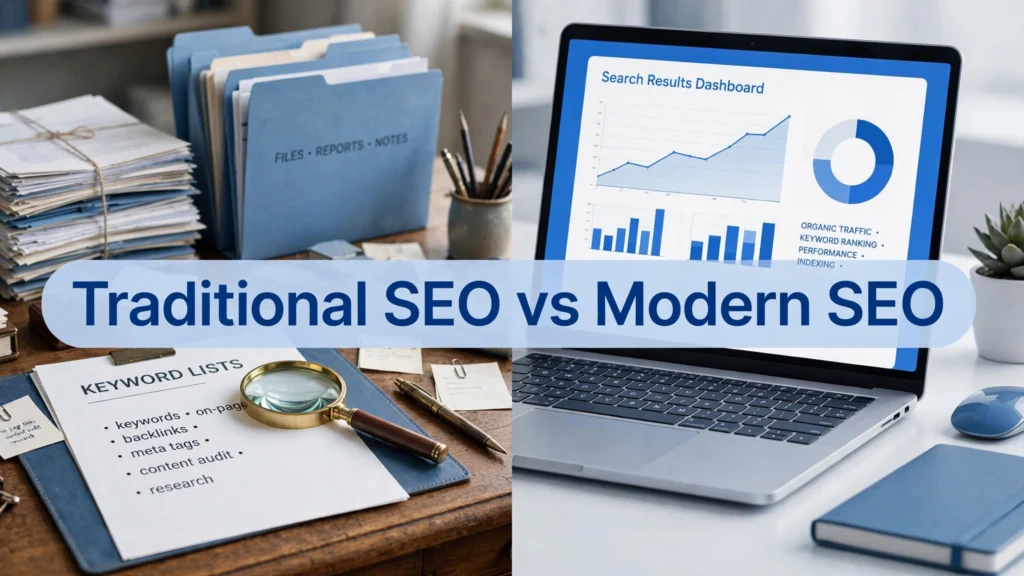
If you have been running a website for a few years, you have probably heard two very different kinds of SEO advice. One tells you to pick a keyword, repeat it as many times as possible, and build as many backlinks as you can. The other tells you to forget the keyword count, answer real questions, fix your technical problems, and earn trust. Both call themselves SEO — and that is exactly why so many business owners are confused.
I work as an SEO specialist, and I have seen both eras up close. In this guide I will explain traditional SEO vs modern SEO in plain language: what each one means, where they differ, what has not changed, and what your business should actually do in 2026. My short answer is this: modern SEO keeps the useful parts of traditional SEO and drops the tricks. If your website still runs on old tactics, you are not just behind — you may be actively holding your own rankings back.
What Is Traditional SEO?
Traditional SEO is the way search optimisation worked in its early years, roughly from the late 1990s through the early 2010s. Google was simpler then, and so was the work. The job was mostly about signals a search engine could count: put the exact keyword in the title, in the headings, in the first paragraph, and many times through the page. Build links from as many websites as possible. Submit the site to directories. Watch the ranking report move.
In my early work I saw websites that ranked well with this approach even when the content was thin, because Google’s systems were not yet good at judging whether a page actually helped the person who clicked it. A page could rank for “plumber in Manchester” with a few hundred words of repetitive text and a footer full of city names. That is not a criticism of the people who did it — at the time, it worked, and it was what the search engines rewarded.
Traditional SEO had a few clear features. First, it was keyword-first: one page, one exact keyword, repeated often. Second, it was ranking-first: success was measured by a position number for a keyword, not by what happened after the click. Third, it treated links as votes that could be collected in bulk — the more links, the better, whatever their source. Fourth, technical work was often an afterthought; if the page loaded and Google could read it, that was usually enough.
None of this was evil. Much of it was simply the best understanding of the time. The problem is that Google kept improving, and the old playbook stopped working — first slowly, then all at once.
What Is Modern SEO?
Modern SEO is the same goal — being found by the right people on Google — done the way today’s search engines actually work. Google now tries to understand what a person means when they search, not just which words they typed. It judges whether a page genuinely helps, whether the site behind it is trustworthy, and whether the page works well on a phone. And since 2023, it increasingly answers questions directly in AI Overviews and in tools like ChatGPT, which means your content now competes to be cited, not just to be clicked.
In my work today, modern SEO has four pillars. The first is search intent: I start every page by asking what the searcher actually wants — information, a comparison, a price, or someone to hire — and then I shape the page to answer that. The second is helpful content: content written from real experience, with examples, honest limits, and clear next steps, not words written to hit a word count. The third is technical health: fast loading, clean crawling and indexing, mobile-friendly pages, and Core Web Vitals that pass. The fourth is trust and authority: consistent information about who you are, real expertise shown on the page, and links and mentions earned because the content deserves them.
If you want the fuller picture of where SEO is heading, I wrote a detailed guide on what modern SEO means today and how search engine optimisation has changed. The short version is that modern SEO is a whole-website discipline, not a set of tricks applied to a page.
Traditional SEO vs Modern SEO: The Key Differences
The clearest way to see the difference is to compare the two approaches side by side, area by area.
Keywords: exact match vs search intent
Traditional SEO picked one exact keyword and repeated it. Modern SEO still uses keywords — I still research them and place them in titles, headings, and introductions — but the question has changed. Instead of asking “how many times can I use this phrase?”, I ask “what does the person typing this phrase actually want?” A page targeting “traditional seo vs modern seo” should explain the comparison clearly, not repeat the phrase twenty times. Google understands synonyms and related topics now, so a page that covers the subject properly will rank for many related searches, not just one exact phrase.
Content: volume vs helpfulness
The old approach often meant publishing as many pages as possible, even thin ones, because more pages meant more chances to rank. The modern approach is the opposite: fewer, better pages that genuinely answer the question. I have written about this before — publishing more content does not always improve Google rankings, and a site full of thin pages can drag the whole site down. One thorough, honest guide usually outperforms ten shallow ones.
Links: quantity vs quality
Traditional SEO collected links in bulk: directories, link exchanges, footer links, and sometimes paid links. Modern SEO treats a link as a recommendation. One link from a respected site in your industry is worth far more than a hundred links from unrelated directories. I still build links — through directories, listings, and content worth citing — but I never buy links and never use link farms. Google’s spam systems are good at spotting manufactured links now, and a bad link profile can cost you more than it gains.
Technical SEO: afterthought vs foundation
In the traditional era, technical work was something you checked once and forgot. Today it is the foundation everything else stands on. If Google cannot crawl your pages, if your site is slow on mobile, or if your pages return errors, the best content in the world will not rank. That is why my technical SEO work — audits, indexing fixes, speed and Core Web Vitals, structured data — comes before or alongside content work, never after it as an afterthought.
Measurement: rankings only vs business results
Traditional SEO reported one number: your position for a keyword. Modern SEO still watches positions, but I also track impressions, clicks, which pages earn them, and — most importantly — whether visitors become enquiries and customers. A page ranking first for a phrase nobody buys from is not a success. A page ranking fifth that brings in real enquiries is.
What Has Not Changed
It would be wrong to say traditional SEO was all useless. Several of its foundations are still essential, and any honest comparison of traditional SEO vs modern SEO has to admit that.
Good titles and meta descriptions still matter — they are still what people see in the search results, and they still decide whether someone clicks. Clear headings still matter, because they help both readers and Google understand a page. Internal links still matter — linking your pages together sensibly is one of the most reliable ways to help Google understand your site, and it is a core part of my on-page SEO work. And relevance still matters: a page must still be about what the searcher asked for.
What changed is not the goal but the standard. Google got better at telling the difference between a page that looks relevant and a page that actually is relevant. The basics survived; the shortcuts did not.
What Traditional SEO Got Wrong (and What to Stop Doing)
If your website was optimised years ago and never updated, there is a good chance some of these old habits are still on it. Here is what I check for first in an audit, and what I recommend removing or fixing.
Keyword stuffing is the first one. If a page repeats the same phrase in every sentence, or hides extra keywords in the footer, it reads badly and Google can recognise it as manipulation. Write naturally, use the keyword where it fits, and use related words and synonyms the rest of the time.
Second, bought or exchanged links. If you paid for links, or joined a scheme that links your site to dozens of unrelated sites, those links are a liability now. I cannot remove other people’s links for you, but I can help you disavow the worst ones and replace them with earned links over time.
Third, thin or doorway pages — pages created for a search engine rather than a person, such as dozens of near-identical location pages that differ only by a city name. If a page adds nothing for the reader, it adds nothing for your rankings either, and it can weaken the pages that do deserve to rank.
Fourth, copied or auto-generated content with no human review. Google’s guidance is clear that content should be helpful and created for people, and its systems are increasingly able to tell when content has no real experience behind it. Every post I publish on this site is written from my own work, with examples I can stand behind — and I say plainly where the limits of my knowledge are.
Finally, ignoring mobile. Traditional SEO was built for desktop search. Today most searches happen on phones, and Google indexes the mobile version of your site first. If your site is hard to use on a phone, that is not a small problem — it is a ranking problem and a business problem.
What Modern SEO Looks Like in Practice
Theory is useful, but business owners usually want to know what the work actually involves. Here is how I approach a website when I move it from traditional to modern SEO.
I start with an audit: I check what Google has indexed, what is ranking, where the technical errors are, and which pages get impressions but no clicks. Search Console tells me most of this for free, and it is the first place I look for every client site.
Then I fix the technical foundation: crawl errors, slow pages, mobile problems, missing or broken structured data. This is unglamorous work, but without it the content work cannot pay off.
Next comes intent mapping: for each important service, I decide what the searcher wants and what the page must do. A service page should make it easy to understand the service and get in touch; a guide like this one should answer the question completely and honestly.
Then I improve or create the content, page by page, with real expertise in it — examples from my work, clear definitions, direct answers, and FAQ sections where they fit. I link pages together where a link genuinely helps the reader, and I link service pages from blog posts where the connection is natural, never just for the sake of it.
Finally, I measure and repeat. SEO is not a one-time project. Rankings move, competitors improve, and Google changes how it shows results. The sites that win are the ones that keep improving a little every month, not the ones that optimise once and stop.
Which Approach Should Your Business Use?
If you are starting from scratch, the answer is simple: use the modern approach from day one. Build on the solid basics — good titles, clear headings, honest content, sensible internal links — and skip the tricks entirely.
If your site was built with traditional SEO years ago, do not panic and do not delete everything. Much of the foundation may still be sound. The practical move is an audit: keep what is genuinely helpful, fix the technical problems, rewrite the pages that are thin or stuffed with keywords, and remove or disavow the links that could hurt you. Then build forward with the modern approach.
And if you are hiring someone to do SEO for you, this comparison is a useful test. Ask any specialist or agency how they work. If their whole pitch is keyword counts and link numbers, they are selling you the old playbook. If they talk about search intent, technical health, helpful content, and the enquiries your site generates, they are working the modern way. I wrote a guide on what an SEO specialist actually does, which explains the day-to-day work in more detail, and it is worth reading before you hire anyone.
How to Move from Traditional to Modern SEO
Here is a short, practical sequence you can follow — or ask your SEO specialist to follow — to bring a website up to date.
First, run a proper audit of the site as it is today: indexation, speed, mobile usability, and a page-by-page content review. You cannot fix what you have not measured.
Second, fix the technical issues before writing new content. A fast, crawlable site makes every later improvement work harder.
Third, review your most important pages — your homepage and your main service pages — and rewrite them for the person reading, not for a keyword count. Make the offer clear, add the questions customers actually ask, and make it easy to contact you.
Fourth, stop publishing thin content and start publishing useful content. One genuinely helpful guide a month beats four shallow posts. If you already have a blog full of thin posts, improve the best ones rather than adding more weak ones.
Fifth, earn links instead of collecting them. Create pages worth citing — guides, checklists, honest comparisons like this one — and list your business in legitimate directories. Avoid anyone who offers you hundreds of links for a low price.
Sixth, set up proper measurement. Search Console is free and tells you which queries bring impressions and clicks; analytics tells you what visitors do next. Review both monthly and let the data decide what you work on next.
You do not have to do all of this in a week. Most small businesses I work with improve steadily over a few months, one area at a time — and that steady progress is exactly what modern SEO rewards.
Frequently Asked Questions
Is traditional SEO completely dead?
No — its foundations are still alive. Titles, headings, keywords, and links still matter. What is dead is the trick-based version: keyword stuffing, mass link building, and thin pages made only for search engines. Modern SEO keeps the foundations and raises the standard.
Can a website rank using only traditional SEO in 2026?
It is very unlikely for competitive keywords. Google’s systems now judge helpfulness, experience, and technical quality. A site using only old tactics can sometimes rank for very low-competition phrases, but it will struggle wherever real competitors are doing modern SEO properly.
What is the biggest difference between traditional SEO and modern SEO?
The biggest difference is the focus. Traditional SEO optimised for search engines — keyword counts and link counts. Modern SEO optimises for people first, and trusts that search engines have become good enough to reward that. In practice, that means intent, helpful content, technical health, and trust instead of repetition and volume.
Does modern SEO take longer to show results?
Honestly, yes — and that is worth saying plainly. Quick tricks could move a ranking in days; genuine authority takes weeks or months to build. But the results last longer, survive Google updates better, and bring visitors who actually become customers. I would rather build something durable than chase a spike that disappears.
Do I need to delete my old SEO content?
Not necessarily. Review it first. Pages that are still helpful can be updated and kept. Pages that are thin, stuffed with keywords, or written for search engines rather than people should be rewritten or removed. An audit tells you which is which — do not delete pages blindly.
Where does AI search fit into modern SEO?
AI Overviews and tools like ChatGPT now answer many questions directly, sometimes without a click to any website. Modern SEO therefore includes making your content easy for AI systems to cite: clear definitions, direct answers, FAQ-format content, and consistent information about who you are. This is the AEO and GEO work I do alongside standard SEO, and it matters more every month.
My Honest Conclusion on Traditional SEO vs Modern SEO
Traditional SEO vs modern SEO is not really a contest between two equal options. One is how search used to work, and the other is how it works now. The businesses that keep winning on Google are the ones that understood the shift early: they stopped chasing keyword counts and started earning trust — with fast, healthy websites, genuinely helpful content, and a reputation built on real work.
If your website still runs on the old playbook, the fix is not a mystery and it is not a single trick. It is an audit, technical fixes, better content, and steady measurement — the same work I do for my clients every month. Start with the audit, fix the foundation, and build from there. If you would like help with that, look at my SEO services and pricing, or contact me for a free consultation and I will tell you honestly what your site needs — and what it does not.