Many business owners come to me with the same story. They have already spent money on ads, boosted a few social media posts, maybe paid someone to “do SEO” for a month — and they are not sure what any of it actually bought them. Traffic went up for a week, then fell back. Enquiries did not follow. And now they are wondering whether digital marketing works at all.
In my experience, the problem is rarely the channel. The problem is that there was no strategy underneath it. That is why your business needs an SEO strategy before investing in digital marketing — not after. SEO is the foundation that makes every other channel work harder, and without it, you are building on sand.
Let me explain what I mean, in plain language, from the work I do every day with small businesses in the UK, the USA and beyond.
What an SEO strategy actually is
An SEO strategy is not a list of keywords. It is a written plan that answers four questions before you spend anything:
- Who are your customers, and what do they search for when they need what you sell?
- Which pages on your website should answer those searches?
- What is stopping Google from showing those pages today?
- How will you know whether it is working?
That is it. When I start work with a new client, I answer these four questions first. I look at the website, I look at what competitors are ranking for, and I look at what real customers type into Google. Only then do I decide what to fix, what to write and what to build. Everything else — ads, social posts, email campaigns — sits on top of that plan.
Without this plan, digital marketing becomes a series of disconnected spends. You run ads to a page that does not explain your service clearly. You post on social media and send people to a website that loads slowly on a phone. You pay for traffic, and the traffic leaves. A strategy stops that waste before it starts.
Why SEO comes before the rest of your marketing
1. SEO tells you what your customers actually want
Paid ads tell you what people click. SEO tells you what people search for when nobody is prompting them. That difference matters.
When I research keywords for a client, I am not guessing. I look at the exact phrases people type: “seo specialist for small business”, “how to rank on google maps”, “affordable seo services uk”. Each phrase is a real person with a real need, at a specific moment. That search data shapes everything — the pages you build, the words you use, even the services you highlight.
No other channel gives you this. Social media shows you what people like. Search shows you what people need. And when you build your marketing around real needs, every channel gets better: your ads target the right phrases, your social posts answer real questions, and your website speaks the language your customers already use.
2. SEO fixes the website your ads send people to
Here is a mistake I see constantly: a business spends hundreds of dollars a month on Google Ads, and the ads send visitors to a homepage that takes six seconds to load, has no clear headline, and hides the contact button below the fold.
Google’s own guidance is clear on this point. The Google SEO Starter Guide explains that a website should be built so that search engines — and people — can understand it easily, with clear titles, useful content and a structure that makes sense. That advice applies to your ads too. If a page is not good enough to rank, it is usually not good enough to convert paid traffic either.
Before I recommend any ad spend, I check the basics: does the site load fast on mobile? Is there a clear page for each service? Can a visitor understand what the business does in five seconds? Can they contact you in one click? Fixing these things first means the money you later spend on ads lands on pages that can actually turn visitors into enquiries.
3. SEO compounds; ads stop the day you stop paying
This is the honest trade-off every business owner should understand. Paid advertising is a tap: turn it on, traffic flows; turn it off, traffic stops. There is nothing wrong with that — ads have their place, especially for a launch or a seasonal push.
But SEO is different. A page that ranks well can bring visitors for months or years after the work is done. A helpful guide, a well-optimised service page, a Google Business Profile that shows up in local searches — these keep working while you sleep. I have written about this before in my guide on why SEO is still important for businesses in 2026, and the same logic applies here: SEO is the only channel that builds an asset instead of renting attention.
That does not mean you should never run ads. It means you should build the asset first, so that when you do pay for traffic, you are sending it somewhere worth visiting — and so that you are not dependent on ads forever.
4. A strategy stops you buying the wrong things
The digital marketing world is full of offers: “guaranteed first page in 30 days”, “1,000 backlinks for $50”, “we will manage your social media for $99 a month”. Without a strategy, it is hard to tell which of these help and which hurt.
With a strategy, the test is simple: does this spend move one of my four plan questions forward? If a service cannot explain how it helps your customers find you on Google, or how it fixes a real problem on your website, it is probably not worth your money. I have seen businesses pay for bulk backlinks that later had to be cleaned up, and pay for social media management that sent traffic to pages nobody had optimised. A strategy is your filter against all of that.
What happens when businesses skip the strategy
I will give you a real pattern from my work, without naming anyone. A small service business came to me after spending on ads for six months. Their website had one page for everything — no separate page for each service, no local pages, no clear titles. Their ads were sending people to that single page, and the page did not answer the specific question the ad had promised.
We stopped the ads for a short while. We built a simple strategy: one page per service, clear titles and descriptions, a Google Business Profile set up properly, and a handful of honest answers to the questions customers actually asked. Only then did we restart the ads — and this time the same budget went further, because visitors landed on pages that matched what they searched for.
I am not claiming a specific result or a percentage improvement, because every business is different and honest SEO never promises numbers in advance. What I can say is this: the same money worked harder once the foundation was in place. That is the pattern I see again and again.
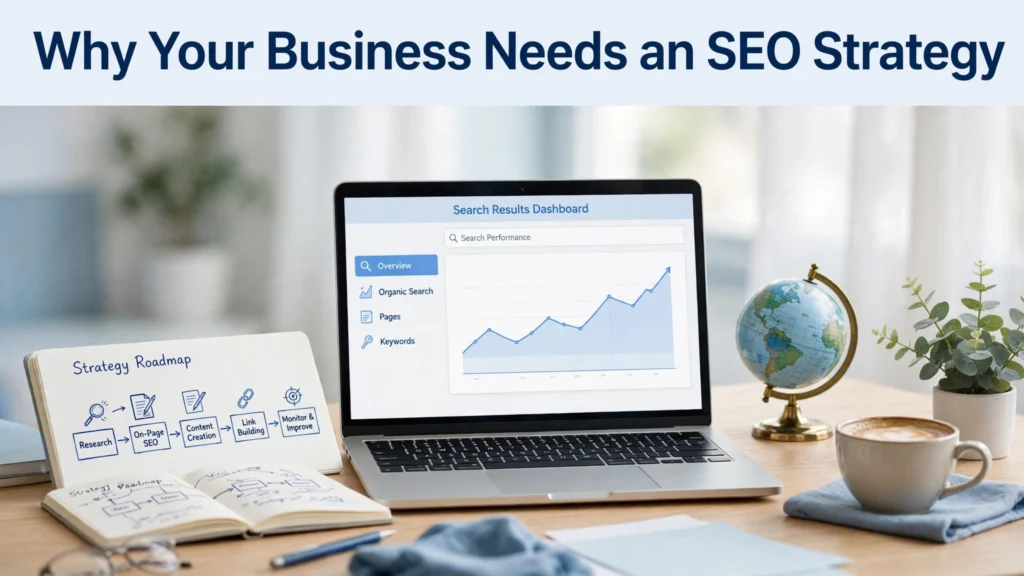
How I build an SEO strategy for a business
If you are wondering what this looks like in practice, here is the order I follow with my own clients. You can use the same order for your business, whether you hire me or do it yourself.
Step 1: Understand the business and the customer
Before I touch a website, I ask what the business sells, who buys it, and where those buyers are. A plumber in Manchester and a software company selling worldwide need completely different strategies. I also ask what a good enquiry looks like — a phone call, a form submission, a booking — because the whole strategy should be built to produce that outcome, not just traffic.
Step 2: Audit the website honestly
I check the technical basics: can Google crawl and index the site? Are pages loading fast enough? Are titles and descriptions written for people or stuffed with keywords? Is there duplicate or thin content? I write down every problem in order of impact, so we fix the things that matter first instead of chasing small details.
This audit step is where most “SEO packages” go wrong. They start with a fixed list of tasks instead of looking at what your website actually needs. A real strategy starts with your website, not with a template.
Step 3: Research keywords by intent, not just volume
I group keywords by what the searcher wants. Someone searching “what is seo” wants to learn. Someone searching “hire seo specialist” wants to buy. Both matter, but they need different pages and different content. A strategy maps each group to a page — or to a page that still needs to be created — so nothing important is left without a home on your website.
Step 4: Fix, then create, then promote
The order matters. First fix what is broken: technical errors, missing titles, slow pages. Then create what is missing: service pages, answers to real customer questions, local pages where they are needed. Then promote: earn mentions and links from real websites, keep your Google Business Profile active, and make sure your business is listed where customers look.
Many businesses do this backwards. They create content before fixing the site, or buy links before having pages worth linking to. A strategy keeps the order right.
Step 5: Measure what matters
Rankings are interesting, but they are not the goal. I track enquiries, calls, form submissions and — where possible — which pages produce them. If a page ranks first but brings no enquiries, the strategy needs to change. If a page on page two brings steady calls, it deserves more attention. The numbers that matter are the ones connected to your business, not vanity metrics.
SEO strategy and your other channels
A good SEO strategy does not replace your other marketing. It improves it.
- Paid ads: your keyword research tells you which phrases are worth bidding on, and your optimised pages raise your ad quality and lower your cost per click.
- Social media: your SEO content gives you real topics to post about — answers to questions your customers actually ask — instead of generic posts.
- Email marketing: your best-ranking pages show you which topics your audience cares about, so your emails start from proven interest.
- Word of mouth and referrals: when someone recommends you, the first thing the new customer does is search your name. A strong search presence — your website, your Google Business Profile, clear information — turns that recommendation into an enquiry.
I explain this to clients as a simple idea: SEO is the foundation, and the other channels are the rooms you build on it. You can build rooms without a foundation, but they will not stand for long.
The cost of waiting
Some business owners tell me they will “do SEO later”, after the ads and the social media are sorted. I understand the thinking — SEO takes time, and ads feel faster. But there is a cost to waiting that is easy to miss.
Every month without a strategy is a month your competitors are building their own foundation. The pages they publish, the reviews they collect, the local presence they build — all of it compounds. SEO rewards consistency over time, and the businesses that start earlier usually have the advantage. That does not mean it is ever too late to start. It means the best time to build a strategy is before you spend heavily on other channels, and the second-best time is now.
You also do not need a huge budget to start. A clear strategy for a small business can be simple: a handful of well-built pages, a properly set up Google Business Profile, and a realistic plan to add useful content each month. My own monthly plans start at $99, and even if you never hire me, the order of work in this article — audit first, fix second, create third, promote fourth — costs you nothing but time.
A short checklist before you spend on digital marketing
Before you approve the next ad campaign or marketing package, run through this list:
- Can Google find and index every important page on your website?
- Does each service have its own page with a clear title?
- Can a visitor understand what you do and contact you within seconds?
- Is your Google Business Profile complete and up to date?
- Do you know which keywords your customers actually search for?
- Do you know what a good result looks like — calls, forms, bookings — and how you will measure it?
If you answered no to more than one of these, your money will work harder after a strategy is in place. Fix the foundation first.
Frequently asked questions
Do I need an SEO strategy if I already run Google Ads?
Yes — arguably more so. Ads send paid traffic to your pages, and an SEO strategy makes sure those pages deserve the traffic. Good pages also tend to improve your ad quality, which can lower what you pay per click.
Can I do SEO myself instead of hiring a specialist?
You can, and many small business owners do the basics well: clear titles, helpful content, a complete Google Business Profile. A specialist earns their fee on the parts that are harder to see — technical problems, keyword research, and knowing what not to do. If you are unsure, a one-off audit is a sensible middle step.
How long does an SEO strategy take to show results?
It depends on your market, your website’s starting point and your competitors. Early improvements — fixed errors, better titles, a completed Business Profile — can show within weeks. Steady growth in rankings and enquiries usually takes a few months of consistent work. Anyone who guarantees a first-page ranking in 30 days is not being honest with you.
Is SEO better than paid ads?
Neither is better in every case. Ads are faster and useful for launches or seasonal demand. SEO builds a lasting asset that keeps bringing visitors without paying per click. Most businesses I work with need both eventually — but SEO first, so the ads have somewhere good to land.
What does an SEO strategy cost?
It depends on the size of your website and your market. My monthly SEO plans start at $99, and UK clients are billed in GBP. A strategy itself is a plan — the cost comes from the work it describes, and a good strategy tells you exactly what that work is before you commit.
My honest conclusion
Digital marketing without an SEO strategy is spending without a plan. You can still get results — ads can work, social media can work — but you will spend more than you need to, and the results will fade the moment you stop paying.
A strategy costs you a little time up front and saves you money for years. It tells you what your customers search for, fixes the pages they land on, and gives every other channel a foundation to stand on. That is why your business needs an SEO strategy before investing in digital marketing — not as an extra, but as the first step.
If you would like help building one, I offer a free consultation where we look at your website together and I tell you honestly what I would fix first. You can see my SEO services and pricing, or contact me directly — and if we are not the right fit, I will tell you that too.
About the author: I’m Md Ashikur Rahman, an SEO Specialist based in Bogura, Bangladesh, working remotely with clients in the UK, USA and beyond. I help small businesses rank higher on Google with on-page, technical, local and international SEO — and I write about what I actually do in my work, not theory.