Trying to improve Google rankings for a UK business website takes more than adding keywords to a few pages. Your site needs to match what UK customers are searching for, explain your services clearly, work well on mobile, and make it easy for Google to discover and understand your important pages.
There is no guaranteed shortcut to a specific position. A practical SEO plan can, however, help you find realistic opportunities, remove technical obstacles and attract visitors who are more likely to become customers. This guide sets out a clear process for UK small businesses and service providers.
1. Start with your customers and the UK search results
Before choosing keywords, define who you serve, what you offer and where you can genuinely provide the service. A business serving customers throughout the UK has different search opportunities from a company that works in one city or region.
Search Google for the services you provide and examine the results. Notice whether Google shows local businesses, service pages, guides, directories or comparison pages. These results give you clues about the searcher’s intent and the type of page that may be useful.
List the questions customers ask before contacting you. Consider their location, budget, problem and stage in the buying process. Use those details to plan pages that answer real questions rather than copying competitors. Google’s guidance on helpful, reliable, people-first content is a useful standard for this work.
2. Choose keywords that match your services
Broad phrases can be attractive, but they are often highly competitive and may not show a clear intention to buy. More specific searches can connect your pages with people looking for a particular service or location.
- Informational: “how does SEO work?”
- Service research: “SEO services UK”
- Specific need: “technical SEO audit for a small business”
- Local service: “SEO consultant in Birmingham”
For each candidate phrase, ask: does it describe a service you actually provide; what would the searcher expect to see; can your page answer that need better; and could the visitor become a customer? Search volume is only one consideration. Relevance and intent matter too.
Give each important page one clear purpose. A service page should explain the service and conversion path; a blog guide should answer an informational question and link readers to the appropriate service when it is genuinely relevant. For an introduction to the basics, read what SEO is and how it works.
3. Create useful pages instead of repeating keywords
A strong page gives readers accurate, specific information and helps them decide what to do next. It does not need to be a certain length, and repeating the target phrase unnaturally will not make it more useful.
Make your experience and process clear. Use examples only when they are real and you can support them. Review AI-assisted copy for accuracy, originality and relevance before publishing. Avoid producing many near-identical articles or location pages that simply swap one town name for another.
Organise related content into a helpful topic structure. A main service page can link to supporting guides on keyword research, on-page optimisation, local SEO and technical SEO. Supporting articles can then point readers back to the relevant service. This helps people navigate and clarifies how your content is connected.
4. Improve the on-page SEO of each important page
On-page SEO makes the subject and purpose of a page easier to understand. Review the following elements:
- SEO title: Write a concise, distinctive title that accurately describes the page.
- Main heading: Use one clear H1 that sets the reader’s expectation.
- Subheadings: Break the content into logical sections using descriptive H2 and H3 headings.
- URL: Use a short, readable address that reflects the topic.
- Meta description: Summarise the page and give the reader a useful reason to click. Google may choose a different snippet for a particular search.
- Images: Use relevant, compressed images and write descriptive alternative text when an image conveys useful information.
- Internal links: Link to related pages with clear anchor text so readers know where a link leads.
For example, a UK ranking guide can naturally point to on-page SEO services when the reader needs help improving page content and metadata. You can also use this on-page SEO improvement checklist to review individual pages.
5. Make internal links useful and easy to follow
Internal links connect pages on your own website. They help visitors find related information and help search engines discover pages and understand their context. Add links where they answer a likely next question; avoid forcing the same keyword-rich anchor into every section.
For a UK business, this guide can link to the UK SEO services page, a relevant service such as technical SEO or local SEO, and a related guide such as the local SEO checklist for small businesses. Link to off-page SEO or international SEO only when those topics fit the reader’s needs.
6. Check crawling, indexing and technical SEO
Technical SEO helps search engines access and interpret your site. It cannot guarantee rankings, but it can remove problems that prevent important pages from being discovered or displayed correctly.
- Check that valuable pages are not blocked by an accidental
noindexdirective or robots.txt rule. - Review the sitemap and make sure it lists the canonical URLs you want discovered.
- Fix broken internal links and use sensible redirects when URLs change.
- Use canonical URLs to manage duplicate or very similar pages appropriately.
- Confirm the site uses HTTPS and works properly on common mobile screen sizes.
- Use accurate structured data where it applies, and validate it before relying on it.
Google Search Console’s URL Inspection tool can help you inspect an individual URL and see Google’s indexed version. Remember that being indexed and ranking well are different things. If crawling, indexing or site performance issues persist, a technical SEO review can help identify and prioritise them.
7. Improve local SEO where you serve customers
If you serve customers in a city, town or defined service area, make that coverage clear and accurate. Keep your business name, contact details, opening hours and service information consistent on your site and legitimate business listings.
If you are eligible for a Google Business Profile, complete it accurately, choose relevant categories, update your hours and respond professionally to reviews. Follow Google’s guidelines for representing a business. Do not claim an office, address or local presence that you do not have.
Location pages should explain what you offer in that area and provide useful, specific information. Do not publish dozens of near-identical pages with only the place name changed. See the small-business local SEO checklist for more practical checks.
8. Build trust with clear, verifiable information
Help visitors understand who is responsible for your content and why they can trust it. Keep your About and Contact pages accessible, explain your experience accurately, show genuine examples where you have permission, and support important claims with reliable sources.
Google discusses experience, expertise, authoritativeness and trustworthiness in its quality guidance. E-E-A-T is a useful way to assess credibility; it is not a single score or switch that guarantees a ranking. Avoid invented testimonials, unsupported results and exaggerated promises.
Earn links by publishing resources people have a reason to reference, contributing useful expertise and building genuine relationships with relevant organisations. Avoid buying bulk links or participating in manipulative schemes. A relevant editorial mention is more valuable than a large number of unrelated links.
9. Improve mobile usability and page performance
Visitors should be able to understand your offer, find a relevant service, read the page and contact you without friction. Test your most important pages on a phone as well as a desktop computer. Check navigation, text size, forms, buttons and contact information.
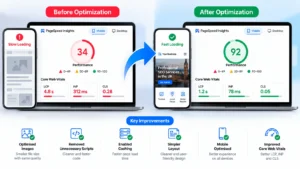
Use PageSpeed Insights to investigate loading performance and Core Web Vitals. Prioritise issues the report identifies rather than chasing a perfect score. Image compression, removing unnecessary scripts, suitable caching and a simpler layout can help, depending on the cause of the slowdown. Google’s Core Web Vitals documentation explains the measurements.
10. Measure progress and improve the plan
Use the Search Console Performance report to review impressions, clicks, click-through rate and average position. Compare these with meaningful business outcomes, such as enquiries or sales, where tracking is available. A rise in traffic alone does not tell you whether the right people are arriving.
Once a month, review the pages gaining or losing visibility, queries with impressions but few clicks, indexing issues, outdated information and internal links between related pages. Make focused improvements and allow time to assess their effect. Results vary by site, competition and implementation, and meaningful organic growth can take months.
A practical starting checklist
- Choose the services and UK locations that are genuinely important to your business.
- Match each target search to a useful page and a clear search intent.
- Improve the titles, headings, content and internal links on your highest-priority pages.
- Use Search Console to inspect indexing and monitor performance.
- Keep local business details accurate and follow Google’s profile guidelines.
- Review progress regularly and update content when it needs new or clearer information.
Improve Google rankings for a UK business website with a focused plan
Sustainable SEO combines relevant keyword targeting, useful content, sound technical foundations, clear internal links, trustworthy information and regular measurement. Start with the pages that matter most to your customers and business, then improve them in a manageable order.
If you want support, explore SEO services for UK businesses or my SEO services. Get in touch to discuss your website and request a practical review of the next steps. No ethical SEO professional can guarantee a specific Google position; the aim is to make measurable improvements that help the right customers find and trust your business.