If you want local SEO in the UK to bring you more calls, enquiries and visits, you need to give Google clear, trustworthy signals about what you do, where you do it and why customers should choose you. Many UK businesses have a decent website but never appear in the map results at the top of Google. The usual causes are an incomplete Google Business Profile, inconsistent business details or a website that does not show local relevance.
This guide explains how local search works in the UK, how to optimise your Google Business Profile (GBP, formerly Google My Business or GMB), and how to build the reviews, citations and trust signals that help your business appear on Google Search and Google Maps. Nobody can promise a particular position, but you can remove obstacles and build the evidence Google looks for.
Key takeaways
- Google says local results are based mainly on relevance, distance and prominence.
- A complete, accurate and verified Google Business Profile is the foundation of local visibility.
- Your website should back up your profile with useful service and location pages.
- Genuine reviews, consistent business details and relevant local links build prominence.
- Fake or concealed incentivised reviews are banned under UK law and breach Google’s rules.
In this guide
About the author: I’m Md Ashikur Rahman, an SEO specialist who works on Google Business Profile optimisation, local on-page SEO and technical SEO for local and international clients, including a UK translation services company featured in my SEO portfolio. This guide draws on Google’s own documentation, UK consumer-law guidance and hands-on project experience. Last updated: 26 October 2026.
What Local SEO in the UK Means for Your Business
Local SEO is the work of making your business easier to find when people search with local intent, such as “electrician in Bristol”, “dentist near me” or “accountant in Glasgow”. For many of these searches Google shows a map with a short list of businesses, often called the local pack, above the standard website results.
It applies to two main types of business. Shops, clinics, restaurants and offices serve customers at a physical address. Service-area businesses, such as plumbers, cleaners and mobile mechanics, travel to their customers. Both can appear on Google Search and Google Maps, but the setup differs, so choose the model that matches how you genuinely operate.
If you are new to the topic, read what SEO is and how it works first, then apply the local tactics below. If you would rather have specialist support, see my local SEO services.
How Google Decides Which Local Businesses Appear
According to Google’s guidance on improving your local ranking, local results are based mainly on three factors: relevance, distance and prominence. Google does not publish exact weightings, so treat them as a framework for prioritising work rather than a formula.
| Factor | What it means | What you can do |
|---|---|---|
| Relevance | How well your profile matches the search | Choose accurate categories, list services and write a clear description |
| Distance | How far you are from the searcher or the location in the query | Keep your address or service areas accurate; you cannot move customers |
| Prominence | How well known and trusted you are | Earn reviews, citations, links and strong website rankings |
Google also says your position in web results can influence local ranking, so conventional SEO still matters. A strong profile and a strong website need to work together.
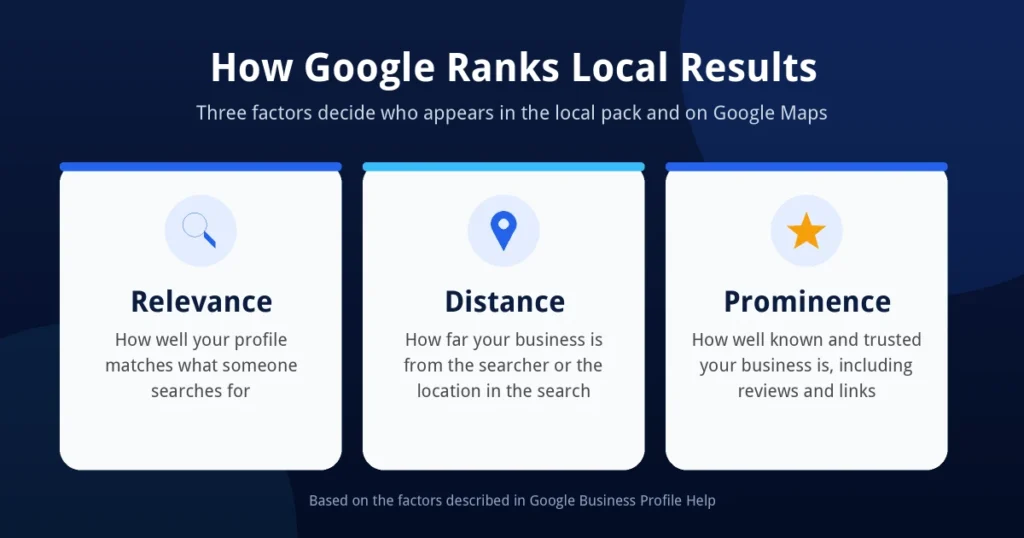
Relevance, distance and prominence are the three factors Google names for local ranking.
How to Optimise Your Google Business Profile
Your Google Business Profile is the free listing that appears in Search and Maps, and it is usually the most important local SEO asset you control. Work through these steps carefully and follow Google’s guidelines for representing your business.
Claim and verify your profile
Search for your business, claim any existing listing and complete verification.
Use your real business name
Use the name customers know you by, as it appears on your signage, website and invoices. Adding keywords or locations that are not part of your name can lead to suspension, and it is not worth the risk.
Choose categories and services carefully
Pick the primary category that best describes your main service, then add secondary categories only where they are accurate. Add each service you offer and write a clear description in plain English that explains what you do, who you help and where, without stuffing keywords.
Set accurate service areas, hours and contact details
If you travel to customers, list the towns or areas you genuinely cover. If you do not serve customers at your address, you can hide it. Keep your phone number and opening hours current, including special hours for UK bank holidays and Christmas, because wrong hours quickly damage trust.
Add real photos and link to the right page
Upload original photos of your premises, team and completed work rather than stock images. Link your profile to the page that best matches the customer’s need. For a multi-location business, that is usually the relevant location page, not the homepage.
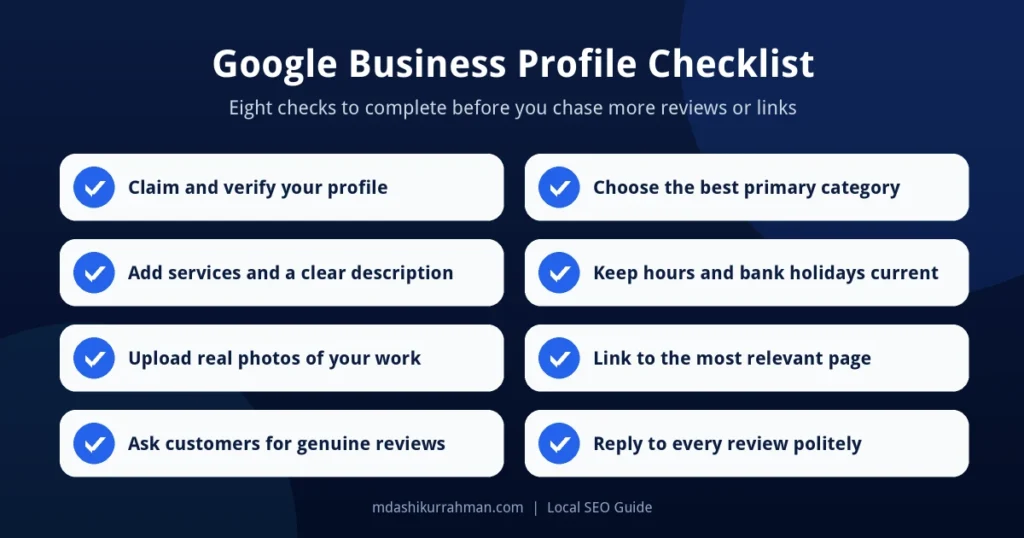
A quick checklist for completing your Google Business Profile.
Make Your Website Support Your Local SEO in the UK
Google uses your website to confirm what your profile says. A thin or generic site gives it very little to work with, so build pages that clearly show what you offer and where.
- Create useful service and location pages. Give each important service its own page. If you genuinely serve several areas, add a page for each with unique information, such as local examples, FAQs and testimonials. Avoid near-identical pages that only swap the town name. My UK SEO services page shows how a location page can be structured.
- Keep your name, address and phone number (NAP) consistent. Show them as crawlable text in your header or footer and on your contact page, matching your profile exactly.
- Optimise titles and headings. Include the service and location naturally, for example “Boiler Repair in Leeds”. My on-page SEO services cover what a well-optimised page involves.
- Add structured data. LocalBusiness structured data helps search engines understand your details.
- Fix speed and mobile usability. Many local searches happen on phones, so test your key pages and resolve slow loading with technical SEO improvements.
For wider ranking advice, read my guide on how to improve Google rankings for a UK business website.
Build E-E-A-T and Trust Signals for Local Search
Google’s quality guidance talks about experience, expertise, authoritativeness and trustworthiness (E-E-A-T), with trust the most important. It is a way of judging credibility, not a score you can switch on. For a local business, trust signals are practical and visible:
- Show who is behind the business. Include named people, short bios and real photos on your About page, as I do on my About page.
- Display proof of experience. Publish case studies, before-and-after examples and project summaries, with the customer’s permission. My SEO portfolio shows one way to present this.
- Show credentials honestly. Where relevant, mention professional memberships and registrations, such as Gas Safe, NICEIC, FCA or SRA, but only if you actually hold them.
- Be transparent. Make contact details, pricing information, your privacy policy and terms easy to find. My SEO pricing page sets out exactly what each plan includes.
Google’s advice on creating helpful, reliable, people-first content is a useful checklist. My article on how modern SEO works beyond keywords explains why these signals matter.
Earn Genuine Google Reviews and Reply to Them
Google says more reviews and positive ratings can improve your local ranking, and reviews also influence whether a customer calls you or a competitor. Make asking part of your routine:
- Ask after you have completed the work, using the direct review link from your profile or a QR code on an invoice or in your premises.
- Ask every customer, not only those you expect to be happy. Selectively asking only happy customers breaches Google’s policies.
- Reply to every review promptly and politely. For negative reviews, acknowledge the issue, stay factual and offer to resolve it offline.
Be careful with incentives. Under the UK’s Digital Markets, Competition and Consumers Act 2024, fake reviews and concealed incentivised reviews have been banned since 6 April 2025, and the Competition and Markets Authority (CMA) can fine businesses up to 10% of global turnover. Read the CMA’s fake reviews guidance before you launch any review campaign.
Build UK Citations, Listings and Local Links
A citation is any mention of your business name, address and phone number on another website. Consistent citations help confirm that your details are accurate, and relevant links add to your prominence. Quality matters far more than quantity:
- Claim Bing Places and Apple Business Connect so maps and assistants outside Google show correct details.
- List your business in respected UK industry directories, trade bodies and your local chamber of commerce.
- Audit existing listings for old addresses, phone numbers or business names, then correct or remove duplicates.
- Earn local links by sponsoring community events, partnering with suppliers, contributing expert comments to local news sites and publishing useful local resources.
Avoid buying bulk links or low-quality directory packages. My off-page SEO page explains how to build authority without risky shortcuts.
Publish Local Content That Answers Real Questions
Content helps you rank for more specific local searches and demonstrates real expertise. Useful ideas include answers to common customer questions, guides to local conditions or regulations, case studies from named areas and seasonal advice.
This also supports newer search experiences. AI-powered answer engines rely on clear, consistent information about businesses, so accurate profiles and well-structured content help there too. Learn more in my guide to AEO and GEO optimisation.
A Simple 5-Step Local SEO Plan for UK Businesses
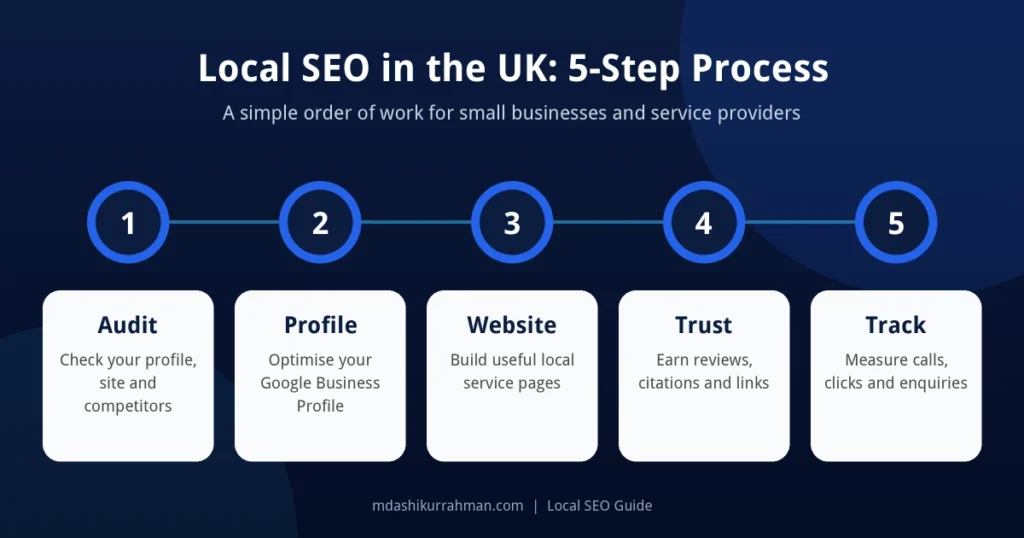
- Audit. Check your profile, website, listings and the competitors in your local pack.
- Fix your profile. Complete every section accurately and resolve duplicates.
- Improve your website. Create or refine service and location pages and add structured data.
- Build trust. Collect genuine reviews, correct your citations and earn relevant local links.
- Measure and refine. Use your profile’s performance data and the Search Console Performance report to track calls, direction requests, clicks and enquiries.
For a task-by-task version, use my simple local SEO checklist for small businesses. Results vary by industry, location and competition, and meaningful progress usually takes weeks or months rather than days.
Local SEO in the UK: Frequently Asked Questions
How long does local SEO take?
It depends on your competition, location and starting point. Fixing a neglected profile can improve visibility within weeks, but competitive markets often take months of steady work. Anyone promising a guaranteed ranking should be treated with caution.
Do I need a website to appear on Google Maps?
You can have a Google Business Profile without a website, but a good site gives Google more information, gives customers more confidence and gives you somewhere to explain your services in detail.
Can I rank in towns where I have no office?
It is harder, because distance is one of Google’s ranking factors. If you are a service-area business, list the areas you genuinely serve and create helpful pages for them. Never use a fake address to appear closer.
Is Google My Business the same as Google Business Profile?
Yes. Google My Business (GMB) was renamed Google Business Profile (GBP).
Final Thoughts: Start With the Basics and Stay Consistent
Effective local SEO in the UK comes from accurate information, a useful website and visible trust. Fix your Google Business Profile first, support it with clear service and location pages, then keep earning genuine reviews and relevant mentions.
Need help with local SEO in the UK?
I help businesses improve their Google Business Profile, local pages and trust signals with honest, step-by-step SEO. Explore my local SEO services, see SEO services for UK businesses or compare pricing plans.