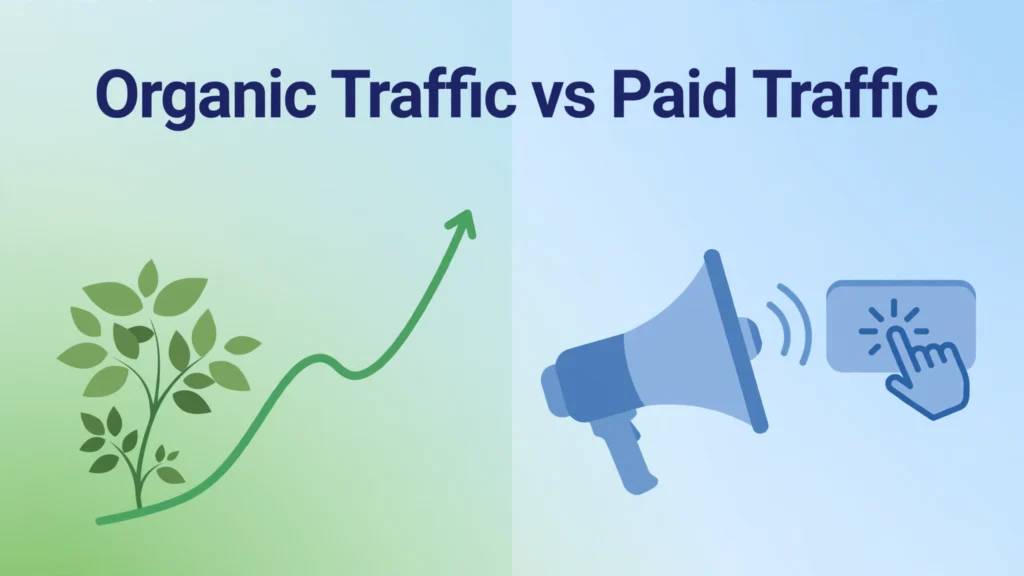
Every business owner who wants more customers from Google eventually asks me the same question: should I pay for ads, or should I invest in SEO and earn traffic for free? My short answer is that organic traffic vs paid traffic is not really a fight between a good channel and a bad one. They do different jobs, they cost money in different ways, and the right choice depends on what your business needs right now — and what it needs in two years’ time.
I am Md Ashikur Rahman, an SEO Specialist, and I work with small and growing businesses in the UK, the USA and other international markets. In this guide I will explain both kinds of traffic in plain language, compare them honestly on cost, speed, trust and long-term value, and show you how I decide which one a business should focus on first. No jargon, no inflated promises — just what I have learned from doing this work every day.
What Is Organic Traffic?
Organic traffic is the traffic that comes to your website from search engines without you paying for each click. When someone types a question into Google, sees your page in the normal search results and clicks on it, that visit is organic traffic.
You earn it by making your website genuinely useful and easy for Google to understand. That is the core of what I do as an SEO specialist: clear page titles, helpful content that answers real questions, a fast and mobile-friendly website, and other websites linking to you because your content is worth recommending. Google’s own SEO Starter Guide describes this in the same way — SEO is about helping search engines understand your content so it can reach the right people.
The most important thing to understand about organic traffic is that it is an asset. A good page can keep bringing visitors for months or years after you publish it. I have seen a single helpful guide keep sending enquiries long after the work of writing it was finished. That is why I wrote earlier about why SEO is still important for businesses in 2026 — the value compounds instead of disappearing the moment you stop paying.
But organic traffic has an honest limit too: it is slow. A new page usually takes weeks or months to rank, and a new website takes longer. If you need customers this week, organic traffic alone will not save you.
What Is Paid Traffic?
Paid traffic is the traffic you buy. The most common form is pay-per-click advertising, such as Google Ads: you bid on keywords, your ad appears at the top of the search results, and you pay every time someone clicks.
The advantage is speed and control. You can launch a campaign today and see visitors today. You can choose the exact keywords, the exact locations, and the exact budget, and you can pause everything in one click. For a new business, a product launch, or a seasonal offer, that control is genuinely valuable.
The limit is just as clear: the traffic stops the moment you stop paying. There is nothing left behind — no page that keeps ranking, no asset that keeps working. And in competitive industries the cost per click can be high, so a badly managed campaign can spend a lot of money without bringing real enquiries. Paid traffic is renting attention. Organic traffic is building something you own.
Organic Traffic vs Paid Traffic: The Key Differences
Let me put the comparison in one place, because this is the part most guides overcomplicate:
Cost. Organic traffic costs time and work, not money per click. Paid traffic costs money per click, and the price can rise as more advertisers compete for the same keywords.
Speed. Paid traffic is immediate. Organic traffic takes time — usually months before a new page reaches its full potential.
Duration. Paid traffic lasts exactly as long as your budget does. Organic traffic can keep working for years after the work is done.
Trust. Many searchers skip the ads and click the organic results. That is not a rule — some people click ads happily — but in my experience, visitors who arrive through a helpful organic page tend to trust the business more, because Google ranked it on merit rather than on payment.
Targeting. Paid ads let you target very precisely: location, device, time of day, even the exact search phrase. Organic targeting is broader — you rank for the topics your content covers, and you cannot switch it on and off.
Measurement. Both are measurable. With paid ads you see cost per click and cost per conversion immediately. With organic traffic you track rankings, impressions and clicks in Google Search Console, and enquiries over time.
Neither column is a clear winner. The right question is not “which is better?” but “which is better for my business, right now?”
The Real Cost Comparison
People often say organic traffic is “free”. It is not free — it is just paid for differently. You pay with your time, or with a specialist’s time, to create content, fix technical problems and build authority. The difference is what happens after you pay.
With paid traffic, every visitor has a price, and that price never goes down to zero. If a keyword costs you a few dollars per click, then a hundred visitors cost a few hundred dollars — every single time. Stop the budget, stop the visitors.
With organic traffic, the cost is front-loaded. Writing a strong guide, optimising a service page and earning a few good links takes real work. But once that page ranks, the next hundred visitors cost you nothing extra. That is the compounding effect I talk about with clients: the work you do this month can still be bringing enquiries next year.
That is also why I am honest about the other side. If your website is brand new, has no content and no authority, organic traffic will not pay your bills this month. In that situation, a small, well-managed paid campaign can bring the first enquiries while the SEO work builds underneath it. This is not a contradiction — it is sequencing.
Which One Brings Better Customers?
This is the question business owners actually care about, and the honest answer is: it depends on the intent behind the click.
Paid traffic can be extremely targeted. If someone searches “hire SEO specialist” and clicks your ad, that person is close to making a decision. The intent is strong. The problem is that the same high-intent keywords are the most expensive ones, and the visitor knows it is an ad.
Organic visitors often arrive earlier in their journey — they searched a question, found your guide, and are still learning. But that early visit builds trust. When they are ready to buy, they remember the business that helped them first. In my work, I have seen organic visitors return weeks later and become clients, because the first visit was useful rather than a sales pitch.
My practical advice: judge a channel by enquiries and customers, not by clicks. A hundred cheap clicks that bring no enquiries are worth less than ten organic visits that bring one real customer. Track what happens after the click — the form fill, the phone call, the sale — and let that decide where your budget goes.
When Paid Traffic Makes Sense
Paid traffic is the right first move when:
- You need enquiries this week, not in three months — for example, a new business or a new service launch.
- You want to test whether a keyword, a service or a landing page actually converts before you invest months of SEO work into it.
- You have a time-limited offer, a seasonal product, or an event with a fixed date.
- Your organic rankings are already strong, and you want to appear twice on the same results page — ad plus organic listing — for your most valuable keywords.
The rule I give clients is simple: use paid ads for speed and testing, never as a permanent replacement for being findable. And set a clear budget and a clear stop rule before you start — decide what a lead is worth to you, and pause any keyword that costs more than that for too long.
When Organic Traffic Makes Sense
Organic traffic is the right priority when:
- You want enquiries that keep coming without a monthly ad bill — the long-term growth this post is about.
- Your customers research before they buy, which is true for most services: they read guides, compare options and check who knows their stuff.
- You are building a brand, not just selling one product. Ranking for helpful topics makes your business the obvious expert in your market.
- Your advertising costs are rising. In competitive markets, cost per click only goes up over time; a strong organic position protects you from that.
This is also where the work I do on service pages matters. A well-optimised service page — clear title, honest description, real service details, easy contact — can rank for the keywords your customers actually type, and turn that traffic into enquiries. You can see how I approach that on my SEO services page.
Why I Recommend Both — In the Right Order
If I had to give one recommendation to most small businesses, it would be this: build organic traffic as the foundation, and use paid traffic as the accelerator.
Start with SEO, because it is the asset that lasts. Fix the technical basics, publish genuinely helpful content, and make your service pages clear and easy to contact. That work keeps paying you back. Then add paid traffic where it earns its money: testing new keywords, supporting a launch, or capturing the highest-intent searches while your organic rankings grow.
The two channels also help each other. Paid ads show you which keywords actually bring enquiries, and that tells you which topics deserve a full SEO effort. Organic content shows you which questions your customers ask, and that tells you which ad messages will resonate. Used together, each one makes the other smarter.
Common Mistakes I See Business Owners Make
Mistake 1: Choosing only paid ads and never building anything that lasts. After a year of advertising, such a business owns nothing — no rankings, no content, no authority. The day the budget stops, the enquiries stop.
Mistake 2: Expecting SEO to work in two weeks. Organic traffic rewards patience. If someone promises you first-page rankings in a week, that is a warning sign, not a selling point.
Mistake 3: Sending paid traffic to a weak page. If your landing page is slow, confusing or has no clear way to contact you, you are paying for clicks that will never become customers. Fix the page first — the same rule applies to organic traffic.
Mistake 4: Judging SEO by traffic alone. More visitors is not the goal; more enquiries is. A page that brings a hundred visitors and no customers is less valuable than a page that brings ten visitors and one customer.
Mistake 5: Treating the two channels as rivals. The businesses that grow fastest online are usually the ones that use both, each for what it is good at.
How to Decide for Your Business
Ask yourself three questions:
- How urgent is it? If you need customers this month, start with a small paid campaign while SEO builds. If you can wait, put the money into the asset.
- How competitive are your keywords? In very competitive markets, paid clicks are expensive and organic ranking is slow — which usually means you need both, and you need a specialist’s help to choose the battles you can actually win.
- What is a customer worth to you? Work out the value of one new customer, then judge every channel by cost per customer, not cost per click. The channel that brings customers at a fair price is the right one, even if the clicks cost more.
If you are not sure where you stand, that is exactly what an SEO audit is for: I look at your rankings, your pages, your competitors and your traffic, and tell you honestly which channel deserves your budget first. You can see the services I offer on my SEO services page, and the pricing is listed openly on my pricing page.
FAQ
Is organic traffic really free?
No. It costs time and expertise to earn — content, technical fixes and authority building. But once a page ranks, each additional visitor costs you nothing, unlike paid clicks, which you pay for every time.
Can a small business compete with big brands using organic traffic?
Yes, and this is one of the best reasons to invest in it. Big brands often target broad, expensive keywords and ignore the specific questions real customers ask. A small business that answers those questions well can outrank a big brand for them. I explained this in detail in my post on how SEO helps small businesses compete with big brands online.
How long does SEO take to work?
It depends on your website, your market and your competition, but in my experience you should expect the first meaningful movement in a few months, not a few days. Pages that rank well tend to keep ranking, which is the trade-off for the wait.
Should I stop paid ads once my SEO starts working?
Not necessarily. Many businesses keep a small paid campaign for their most valuable keywords even after organic traffic grows, because appearing twice on a results page brings more enquiries. The difference is that the ads become a choice, not a lifeline.
Which one is better for long-term business growth?
For most businesses, organic traffic — because it compounds, builds trust and keeps working after the work is done. But the fastest growth usually comes from using both: SEO as the foundation, paid ads as the accelerator.
My Honest Conclusion on Organic Traffic vs Paid Traffic
Organic traffic vs paid traffic is not a contest with one winner. Paid traffic buys you speed and control today. Organic traffic builds you an asset that works tomorrow, next month and next year. If you can only afford one, and you are thinking about the next two years rather than the next two weeks, I would choose organic — because a business that is findable without paying for every click is a business that is hard to stop.
But the best answer for most businesses is both, in the right order: build the foundation with SEO, then use paid traffic where it earns its keep. That is the approach I take with my own clients, and it is the approach I would take with your business too.
If you want help deciding which channel deserves your budget first — or you want me to look at your website and tell you honestly where you stand — get in touch. You can read about my SEO services, check the pricing, or contact me directly for a free consultation. Contact us today and let us build traffic that keeps working for your business.