So, what is SEO, and how can you use it to bring more visitors to your own website? If you have ever searched on Google and clicked one of the first few results, you have already seen SEO at work.
I’m Md Ashikur Rahman, an SEO specialist with more than two years of hands-on experience and 50+ website projects behind me, from small local businesses to growing blogs and online stores. In that time, I have seen what works, what wastes time, and what beginners most often get wrong. This guide shares the lessons that matter most, in plain language.
What Is SEO?
SEO stands for Search Engine Optimization. It is the practice of improving your website so that search engines like Google can find it, understand it, and show it to people searching for what you offer. Google also explains the fundamentals in its official SEO Starter Guide.
When someone types a question into Google, the search engine scans billions of pages and decides which ones deserve to appear first. SEO is how you help your pages earn those top positions without paying for ads.
The traffic that comes from these unpaid results is called organic traffic. It is valuable because the visitors are actively looking for information, products, or services like yours.
Why Is SEO Important for Your Website?
Here are the main reasons SEO matters:
- It brings consistent, targeted traffic. People who find you through search are already interested in your topic.
- It builds credibility. Users tend to trust websites that appear at the top of search results.
- It is cost-effective over time. Unlike paid ads, which stop the moment your budget ends, a well-optimized page can keep attracting visitors for months or even years.
- It supports every other marketing channel. A fast, clear, helpful website improves your social media, email, and advertising results too.
Across the projects I have handled, the websites that treated SEO as a long-term investment, rather than a quick fix, always saw the most stable growth.
How Does Google Rank Websites?
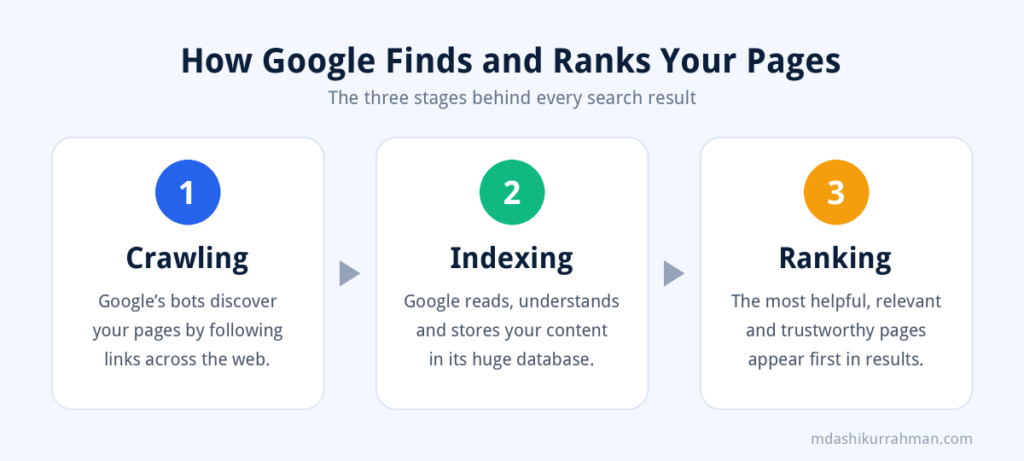
Google uses automated programs called crawlers to discover pages across the internet. The process has three main stages:
- Crawling: Google finds your pages by following links.
- Indexing: Google stores and organizes the content it finds.
- Ranking: When someone searches, Google selects the most relevant and helpful pages from its index and orders them.
Google does not publish its full algorithm, but it has been clear about what it values: helpful content, a good user experience, and trustworthy sources. This is where the concept of E-E-A-T comes in.
What Is E-E-A-T?
E-E-A-T stands for Experience, Expertise, Authoritativeness, and Trustworthiness. It is a framework used in Google’s quality guidelines to evaluate content, and it ties closely to Google’s advice on creating helpful, people-first content. To strengthen it on your own site:
- Show real, first-hand experience with your topic.
- Add author bios with relevant credentials.
- Cite reliable sources and keep information accurate and up to date.
- Display contact details, an about page, and clear privacy policies.
In my own work, adding genuine author information and real examples to pages often made a noticeable difference in how confidently those pages performed.
The Three Main Types of SEO
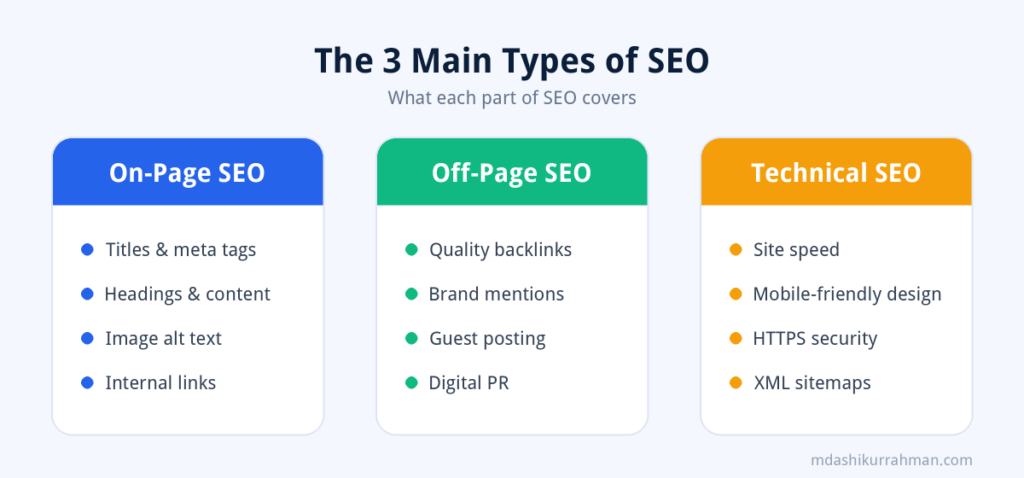
To fully answer the question “what is SEO,” you need to know that it has several parts that work together.
1. On-Page SEO
On-page SEO covers everything you can control directly on your pages, including:
- Title tags and meta descriptions
- Headings (H1, H2, H3)
- Content quality and keyword usage
- Image alt text
- Internal links
If you want a deeper walkthrough, read my post on 7 practical on-page SEO improvements you can make today, or explore my on-page SEO services.
2. Off-Page SEO
Off-page SEO covers signals from outside your website. The most important is backlinks, which are links from other websites to yours. A link from a respected website works like a vote of confidence. Quality matters far more than quantity. You can learn how I approach this on my off-page SEO page.
3. Technical SEO
Technical SEO ensures that search engines can crawl and index your site without problems. It includes site speed, mobile-friendliness, secure HTTPS connections, clean URL structures, and XML sitemaps. See how I handle these fixes in my technical SEO service.
7 Practical Steps to Rank Higher on Google
Now for the actionable part. These are the steps I follow and recommend when starting a new SEO project.
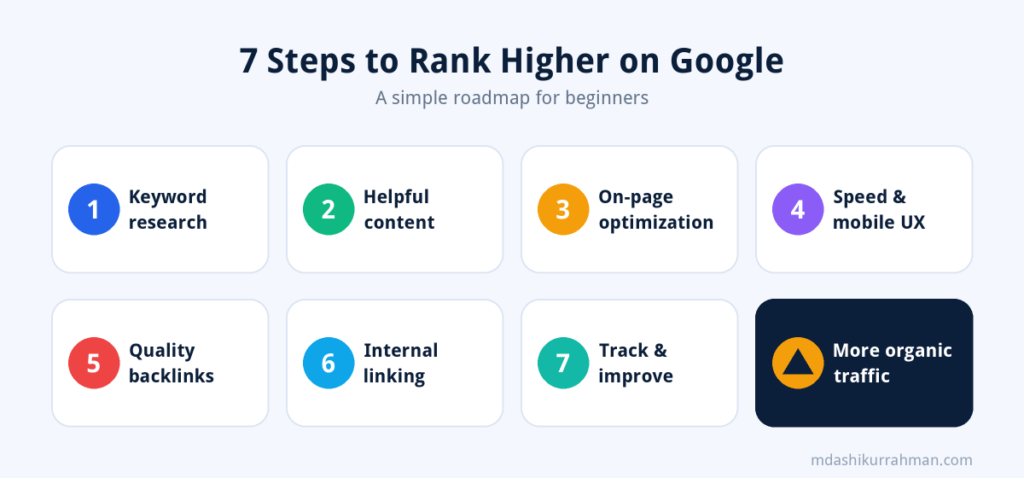
Step 1: Start With Keyword Research
Keywords are the words and phrases people type into Google. Your goal is to find terms that your audience searches for and that you realistically have a chance to rank for.
Focus on search intent, which is the reason behind a search. Someone searching “what is SEO” wants an explanation, while someone searching “SEO services near me” wants to hire someone. Match your content to the intent.
Free tools like Google Keyword Planner and Google Search Console are a good start. Beginners should aim for specific, lower-competition phrases before targeting highly competitive ones.
Step 2: Create Helpful, Original Content
Google’s systems are designed to reward content written for people, not for search engines. Answer the reader’s question fully, use clear language, and add your own insights or examples. For more on this, see how modern SEO works beyond keywords.
Avoid copying competitors or stuffing keywords unnaturally. After working on dozens of sites, I can say this plainly: thin, repetitive content rarely holds its rankings.
Step 3: Optimize Your On-Page Elements
Make sure each page has:
- A unique title tag that includes your main keyword, ideally under 60 characters
- A compelling meta description of around 150 to 160 characters
- A single H1 heading that clearly states the topic
- H2 and H3 subheadings that organize the content logically
- Descriptive alt text on images
- A clean, short URL
Step 4: Improve Page Speed and Mobile Experience
Most searches now happen on mobile devices, and Google primarily uses the mobile version of your site for indexing. Slow or hard-to-use pages frustrate visitors and weaken your performance.
To improve this, compress your images, use reliable hosting, minimize unnecessary scripts, and choose a responsive design. You can check your performance with Google’s PageSpeed Insights.
Step 5: Build Quality Backlinks
Earning links takes patience. Some effective and safe approaches include:
- Publishing original research or genuinely useful guides that others want to reference
- Guest posting on respected websites in your niche
- Building relationships with other site owners and bloggers
- Creating shareable resources such as checklists or templates
Avoid buying links or joining link schemes. These can lead to penalties and undo your hard work.
Step 6: Use Internal Linking
Internal links connect your pages to each other. They help Google discover your content and help visitors move naturally through your site. When you publish a new post, link to it from related older pages, and link from it to relevant existing content.
If you run a local business, my simple local SEO checklist is a good next read.
Step 7: Track, Measure, and Improve
SEO is never “finished.” Use Google Search Console to see which queries bring impressions and clicks, and Google Analytics to understand how visitors behave on your site.
Common SEO Mistakes Beginners Should Avoid
Over the years, I have noticed the same errors appear again and again:
- Targeting keywords that are too competitive. New sites should start with more specific phrases.
- Ignoring search intent. Even well-written content will not rank if it does not match what searchers want.
- Neglecting technical basics. Broken links, slow pages, and missing mobile optimization hold many sites back.
- Expecting instant results. SEO usually takes several months to show meaningful progress.
- Copying content. Duplicate or low-value content adds nothing for users or for search engines.
How Long Does SEO Take to Work?
This is the question beginners ask most often. In my experience, new websites typically need three to six months before seeing steady improvement, and competitive topics can take longer.
Final Thoughts: What Is SEO Really About?
So, what is SEO? It is the ongoing process of making your website more visible, more useful, and more trustworthy to both search engines and real people. It is not about tricks or shortcuts. It is about understanding what your audience needs and delivering it better than anyone else.
If you are just starting out, focus on the basics: research your keywords, write helpful content, keep your site fast and easy to use, and build your credibility steadily. After two years and more than 50 projects, I can confidently say that the websites that follow these fundamentals consistently are the ones that rise and stay on page one.
Ready to improve your website’s rankings? Start with one step from this guide today, or explore my SEO services and contact me if you would like expert help.