By Md Ashikur Rahman, SEO Specialist, Bogura, Bangladesh · Last updated: October 22, 2026
You published the pages, installed a plugin, maybe even paid someone for “SEO,” and you are still stuck with a website not ranking on Google, losing organic traffic and leads. It is frustrating, and I hear it almost every week from business owners.
I’m Md Ashikur Rahman, an SEO specialist. Over 2+ years I’ve worked on 50+ projects for 20+ clients, and the pattern is consistent: websites rarely fail to rank for one mysterious reason. They fail because of a handful of fixable problems. In this guide I’ll walk you through the ones I see most often and how I fix them. If you are brand new to the topic, start with my beginner’s guide to what SEO is first.
In this guide
- Quick answer
- Google can’t crawl or index your pages
- Your content doesn’t match search intent
- Your content is thin or generic
- Weak E-E-A-T and trust signals
- Technical SEO and page experience problems
- Weak on-page SEO
- Missing backlinks and authority
- Keywords that are too competitive
- Weak local and AI search visibility
- Not giving SEO enough time
- How I diagnose a website not ranking on Google
- Frequently asked questions
Quick Answer: Why Is My Website Not Ranking on Google?
1. Google Can’t Crawl or Index Your Pages
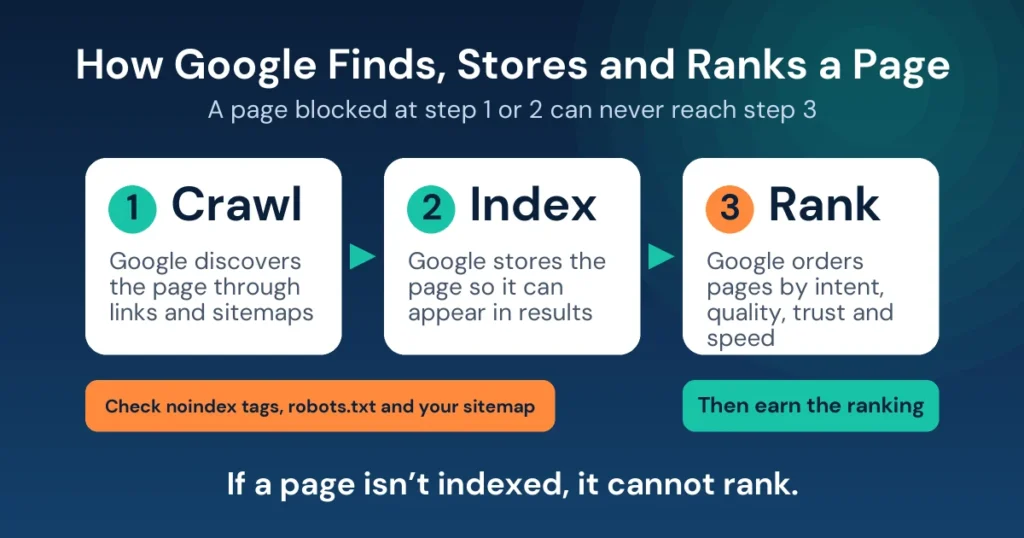
If a page isn’t indexed, it cannot rank. Period. This is the first thing I check, and it is surprisingly common after a site redesign or migration.
How to check: Open Google Search Console, use the URL Inspection tool, and see whether the page is “Indexed.” Also search site:yourdomain.com in Google.
How to fix it:
- Remove accidental noindex tags (a common leftover from development).
- Check that
robots.txtisn’t blocking important folders. - Submit an XML sitemap in Search Console.
- Link to the page from other pages so crawlers can discover it.
Indexing problems are part of a wider technical audit. See my technical SEO services for how I handle crawl errors, site structure and speed.
2. Your Content Doesn’t Match Search Intent
Search intent is the reason behind a query. If someone searches “SEO specialist in Bogura,” they want a service provider. If they search “what is SEO,” they want an explanation. Publishing the wrong type of page for a keyword is one of the fastest ways to stay invisible.
How to fix it: Search your target keyword, study the top ten results, and note the format (guide, service page, list, comparison). Then build the page type Google already rewards, and make it better. Match the intent first, and optimize second. My article on how modern SEO works beyond keywords explains this shift in more detail.
3. Your Content Is Thin, Generic, or Adds Nothing New
Google’s recent core updates have kept pushing in one direction: reward content with real value and original insight, and demote pages that only repeat what is already online. Rewritten competitor articles and bulk AI content with no human verification are exactly what struggles now. Google’s own guidance on creating helpful, people-first content says the same thing.
Ask yourself honestly: is there anything on this page that a reader can’t find on dozens of other sites?
How to fix it:
- Add your own experience, examples, screenshots, data, or process.
- Answer the question in the first few lines, then go deeper.
- Remove filler. Longer is not better; more useful is better.
- Update outdated pages instead of publishing new thin ones.
4. Weak E-E-A-T and Trust Signals
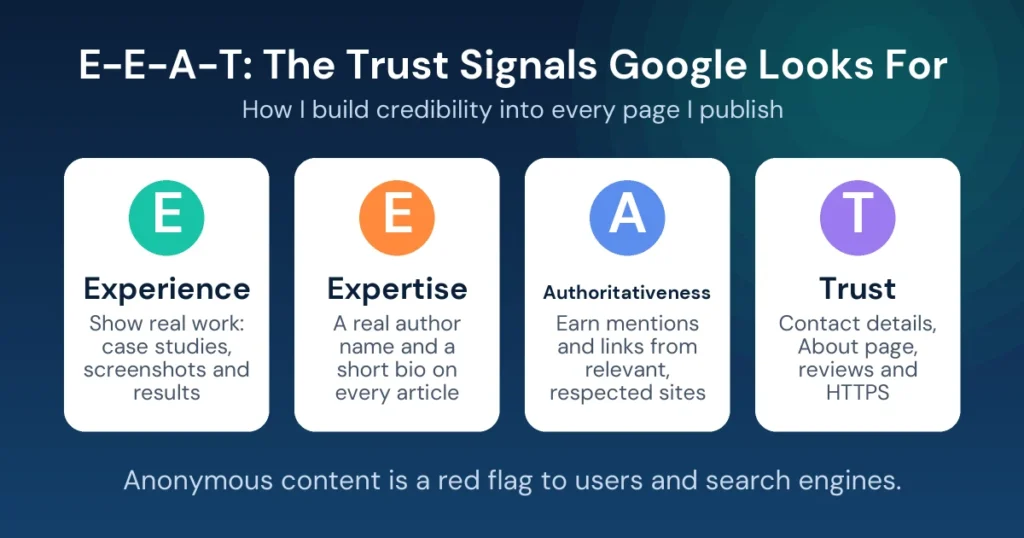
E-E-A-T stands for Experience, Expertise, Authoritativeness, and Trustworthiness. It is not a single ranking factor, but it describes what Google’s quality systems try to reward, especially for topics where bad advice can hurt people.
How to build it:
- Experience: Show first-hand work such as case studies, real screenshots, and results. You can see examples in my SEO portfolio.
- Expertise: Put a real author name and a short bio on every article.
- Authoritativeness: Earn mentions and links from relevant, respected sites.
- Trust: Display contact details, an About page, a privacy policy, reviews, and a secure HTTPS connection.
Anonymous content with no visible person or business behind it is a red flag to both users and search engines. That is why every page I publish clearly shows who wrote it, who is behind the site, and how to reach me.
5. Technical SEO and Page Experience Problems
A slow, unstable site frustrates visitors, and frustrated visitors don’t convert. Google measures page experience through Core Web Vitals: loading speed (LCP), responsiveness (INP), and visual stability (CLS).
Common culprits I fix: oversized images, too many plugins loading unnecessary CSS and JavaScript, no caching, layout jumps while the page loads, and a poor mobile layout.
How to fix it: Test with PageSpeed Insights, compress and lazy-load images, host fonts locally, enable caching, remove unused plugins, and always check the mobile version first, because Google primarily uses it for indexing. If you want an expert to handle this, see my technical SEO service.
6. Weak On-Page SEO
Even great content struggles if the basics are off. On-page SEO tells Google exactly what each page is about.
Checklist:
- One clear primary keyword per page, in the title tag, H1, URL, and first paragraph.
- A compelling title (about 50–60 characters) and a meta description that earns the click.
- Logical headings (H2, H3) that include related terms naturally.
- Descriptive image alt text.
- Internal links pointing to and from related pages with meaningful anchor text.
Avoid keyword stuffing. Write for people, then refine for search engines. For a step-by-step list, read 7 practical on-page SEO improvements you can make today, or explore my on-page SEO services.
7. You’re Missing Backlinks and Authority
Links remain one of Google’s strongest signals of trust. If competitors have dozens of quality sites linking to them and you have none, content alone rarely closes the gap.
How to fix it: Create genuinely link-worthy assets such as original research, tools, or detailed guides. Pitch relevant blogs, contribute expert comments, list your business in reputable directories, and build real relationships. Skip link farms and cheap bulk packages. They can do more harm than good. My off-page SEO service focuses on safe, relevant link building.
8. You’re Targeting Keywords That Are Too Competitive
A new website targeting “SEO services” is competing with established agencies with years of authority. That is a battle you’ll likely lose today.
How to fix it: Do proper keyword research and start with specific, lower-competition, high-intent keywords, such as “on-page SEO for small business” or location-based terms. Win those, build topical authority around them, and then move up to broader terms.
9. Your Local and AI Search Visibility Is Weak
Search is no longer just ten blue links. Google shows AI Overviews, and tools like ChatGPT and Perplexity answer questions directly. Being the source they cite is now part of SEO, often called AEO (Answer Engine Optimization) and GEO (Generative Engine Optimization).
How to optimize for it:
- Give clear, direct answers under question-style headings.
- Use structured data (schema) such as Article, FAQ, Organization, and LocalBusiness.
- Keep your business name, address, and phone details consistent everywhere.
- Build a Google Business Profile for local searches.
- Establish yourself as a recognizable entity with a consistent name, bio, and presence across the web.
Content that is clear, factual, and well-structured is far easier for both search engines and AI systems to understand and quote. I cover this in my AEO and GEO optimization service and my local SEO services. If you run a small business, my simple local SEO checklist is a good place to start.
10. You’re Not Giving SEO Enough Time
SEO is not an overnight channel. New sites often need several months to gain traction, and after a core update, meaningful content improvements may not fully register until the next update cycle. Rankings also fluctuate during an update rollout, so don’t panic or rewrite everything in the first week.
The goal is steady progress: better content, stronger authority, and a healthier site, reviewed monthly.
How I Diagnose a Website Not Ranking on Google
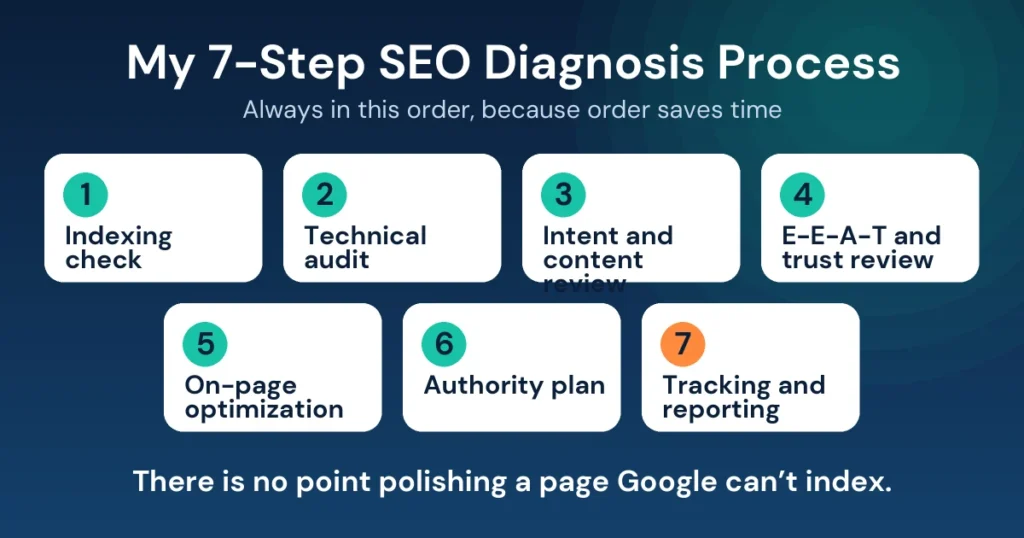
When a client comes to me, I follow the same order every time:
- Indexing check in Google Search Console.
- Technical audit covering speed, mobile, crawl errors, and site structure.
- Intent and content review of every target page.
- E-E-A-T and trust review including authorship, reviews, and credibility.
- On-page optimization of titles, headings, links, and schema.
- Authority plan for quality backlinks.
- Tracking and monthly reporting, so progress is measurable, not guesswork.
Fixing problems in this order saves time, because there’s no point polishing content on a page Google can’t even index.

About the author
I’m Md Ashikur Rahman, an SEO specialist based in Bogura, Bangladesh. With 2+ years of hands-on experience across 50+ projects and 20+ clients, I help businesses grow online with data-driven SEO strategies that improve rankings, traffic, and leads. My work covers on-page SEO, technical SEO, local SEO, and AI-search optimization. Explore my SEO services or get in touch.
Frequently Asked Questions
Why is my new website not showing on Google?
New sites need time to be discovered and indexed. Submit your sitemap in Google Search Console, make sure pages aren’t set to noindex, and build a few quality links. Indexing can take days, but ranking well usually takes months.
How long does it take for SEO to work?
Most websites see early movement within three to six months, depending on competition, site quality, and consistency. Highly competitive keywords take longer.
Why did my rankings suddenly drop?
Common causes include a Google core update, technical changes such as a migration or accidental noindex, lost backlinks, or stronger competitors. Check Search Console to see which pages and queries dropped before changing anything.
Does AI-generated content rank on Google?
Google doesn’t ban AI content, but it rewards helpful, original, and accurate content. Unedited, mass-produced AI text with no real expertise tends to perform poorly. Use AI as an assistant, then add human experience and fact-checking.
Do I need to hire an SEO specialist?
Not always, but if you’ve fixed the basics and still can’t rank, an experienced specialist can find hidden issues faster and build a plan that saves months of trial and error. You can see my packages on the pricing page.
Final Thoughts
A website not ranking on Google isn’t a mystery, and it isn’t permanent. Start with indexing, match search intent, publish content that genuinely helps, build real trust signals, keep your site fast, and earn authority steadily. Do these consistently, and you will fix SEO ranking problems at the root instead of patching symptoms. Rankings follow.
Want a clear answer on what’s holding your site back?
Get a free SEO audit and I’ll show you exactly where to start.
Keep reading: What Is SEO? A Beginner’s Guide · How Modern SEO Works Beyond Keywords · 7 Practical On-Page SEO Improvements